
Steel Jacketing is the “surgical precision” alternative to Concrete Jacketing. While concrete jacketing is about adding bulk and mass, steel jacketing is about confinement and speed.
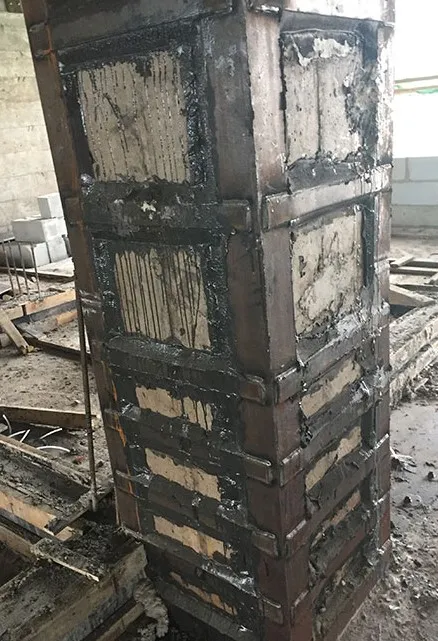
It involves encasing an existing structural member (usually a column) with steel plates and steel angles. The steel acts like a tight “corset” or an exoskeleton, preventing the concrete from expanding outwards when crushed by heavy loads.
Here is an elaborate breakdown of the technique, the science, and the specific scenarios where this is the best choice.
1. The Engineering Objective
Unlike concrete jacketing, which adds vertical load capacity by adding more material to carry the weight, Steel Jacketing works primarily through Passive Confinement.
Confinement Action: When a concrete column is overloaded, it tries to bulge outwards before it cracks. The steel jacket prevents this bulging. By confining the concrete, its ability to bear weight increases significantly without adding much size.
Shear Strength: The horizontal steel straps act like external stirrups, making the column highly resistant to “shear” forces (sideways snapping forces), which is crucial during earthquakes.
2. The Step-by-Step Execution Process
Steel jacketing is faster and “drier” than concrete jacketing (no wet cement mixing on site), but it requires high-precision metalwork.
Step A: Surface Preparation
The existing plaster is removed.
Unlike concrete jacketing (where we want a rough surface), here the surface is cleaned and leveled. Any major unevenness is smoothed out so the steel plates can sit as close to the concrete as possible.
Step B: Fabrication and Placement
Steel Angles: L-shaped steel angles are placed at the four corners of the rectangular column.
Steel Strips (Battens): Horizontal steel strips are welded to the corner angles, forming a cage.
Full Plating (Optional): In cases requiring extreme strengthening, full steel plates may cover the entire face of the column instead of just strips.
Step C: Clamping and Welding
The steel cage is clamped tightly against the column using specialized clamps.
Welders weld the horizontal strips to the corner angles. As the weld cools, it shrinks, naturally tightening the steel cage around the concrete.
Step D: Grouting (The Critical Link)
There is always a microscopic gap between the rough concrete surface and the flat steel plate. If this gap exists, the jacket won’t work.
Pressure Grouting: Low-viscosity epoxy resin or non-shrink polymer grout is injected under pressure into this gap. This turns the concrete and steel into a single, composite unit.
Step E: Protection
Anti-Corrosion: The steel is primed and painted with anti-rust coatings.
Fire-Proofing: Since steel loses strength in a fire, the jacket is usually covered with a fire-resistant plaster, board, or vermiculite spray.
3. Who Needs This Service? (The Target Audience)
Steel Jacketing is a premium service often chosen when space or time is a constraint.
A. Commercial Establishments (Malls, Offices, Hotels)
The Scenario: A shopping mall or IT park needs to strengthen columns to install heavy servers or new machinery.
The Problem: They cannot afford to close the building for weeks for concrete curing, nor can they handle the mess of wet cement in a functioning office.
The Solution: Steel jacketing is a “dry” process. It can be done at night, and the column is at full strength immediately after the epoxy cures (24 hours).
B. Parking Lots and Basements
The Scenario: An apartment complex needs to strengthen basement columns.
The Problem: Concrete jacketing adds 4–6 inches to the column size. In a tight parking lot, this might make parking spaces too narrow for cars to fit.
The Solution: Steel jacketing adds only about 1 inch to the column thickness, saving valuable floor space.
C. Industrial Factories
The Scenario: A factory wants to install a heavy overhead crane on existing columns.
The Problem: The columns need high impact resistance and protection from forklifts hitting them.
The Solution: The steel jacket acts as armor. It strengthens the column and protects the concrete from physical impact damage.
D. Heritage Conservationists
The Scenario: An antique building needs structural support, but the owners don’t want to alter the look with bulky concrete.
The Problem: Maintaining the original architectural proportion is vital.
The Solution: Steel jacketing is slim. Once covered with a thin layer of plaster, it is barely noticeable, maintaining the original visual profile of the building.
E. Emergency Disaster Repair
The Scenario: A building has been damaged by a minor earthquake or an accidental impact (e.g., a truck hitting a pillar).
The Problem: The building is unstable and needs immediate stabilization.
The Solution: Steel jacketing is the fastest method to restore safety. It can be fabricated and installed in days, acting as an emergency splint.
4. Pros and Cons Summary
| Advantages | Disadvantages |
| Speed: No curing time required. Full strength is achieved in 1-2 days. | Cost: Steel is significantly more expensive than concrete. |
| Space Saving: Adds minimal thickness (usually < 2 inches). | Fire Risk: Steel weakens rapidly in fire; requires expensive fire-proofing. |
| Cleanliness: No mixing of sand/cement; ideal for occupied buildings. | Maintenance: Steel can corrode if the waterproofing fails. |
| Ductility: Excellent for earthquake resistance (makes columns flexible). | Skilled Labor: Requires certified welders, not just masons. |
Conclusion
Steel Jacketing is the solution for the client who says, “I need it strong, I need it fast, and I don’t have space to spare.” While it costs more than concrete jacketing, the speed of execution and the preservation of carpet area often make it the smarter financial choice for commercial and industrial properties.
