
The Home Owner’s Playbook: The Invisible Money Pit Hidden Costs of Construction: Identifying Unlisted Expenses
Welcome to the Thaḷi Connect Home Owner’s Playbook. If you are reading this, you are likely standing at the edge of one of the biggest financial cliffs of your life: building your first home.
In Chennai, we worry about water stagnation; in Coimbatore, we worry about the hardness of the bedrock; in Madurai, we worry about heat retention. But across all these regions, there is one universal fear that keeps every first-time home builder awake at 3 AM: “Will I run out of money halfway through?”
You have your quote. You have your loan sanction letter. You think the numbers match. I am here to tell you, with the authority of the Thaḷi Connect ecosystem behind me, that your math is likely missing about 20% of the actual picture. We call these the “Ghosts of Construction”—the costs that nobody writes down until the bill is due.
This guide is designed to hand you a flashlight so you can see these ghosts before they haunt your bank account.
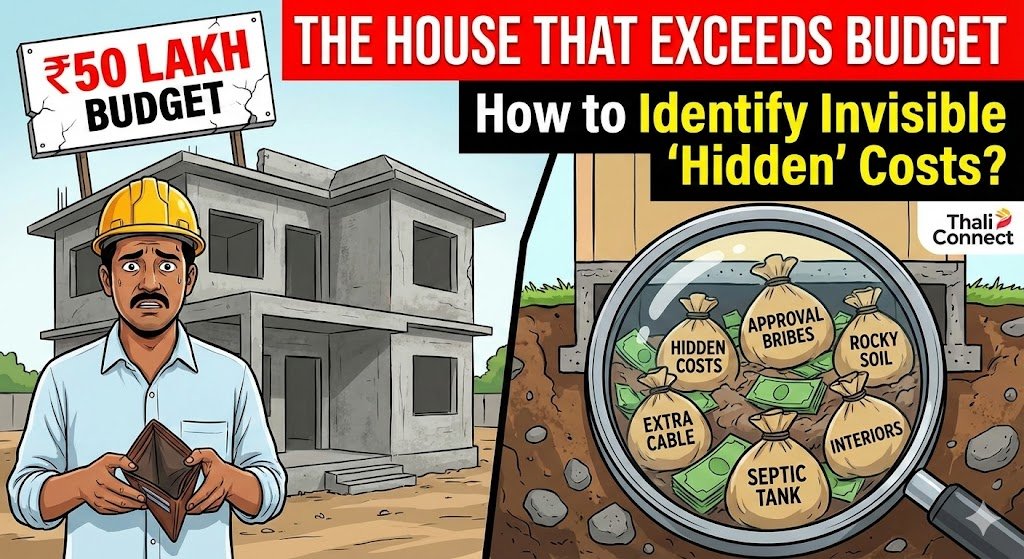
Hidden Costs in construction refer to the expenses that are necessary to complete your home but are rarely included in the initial “Price Per Square Foot” quote given by contractors.
Think of it like buying a car. The brochure gives you the “Ex-Showroom Price.” But you cannot drive the car home for that price. You need to pay for insurance, registration, road tax, accessories, and the extended warranty.
In construction, the “Ex-Showroom Price” is the building structure (Foundation, Walls, Roof). The Hidden Costs are everything else required to make that structure livable and legal.
These include:
Administrative Costs: Government approvals, bri*** (let’s be honest about the market reality, even if we call them “facilitation fees”), and registration fees.
Site Enablement: Temporary electricity, water for curing, and housing for laborers.
External Development: Compound walls, gates, driveways, and septic tanks.
Variable Allowances: The difference between the “standard tile” the builder budgeted for and the “premium tile” you actually fell in love with at the showroom.
Simply put: The quote covers the house. Hidden costs cover the home.
Why it matters?
Why should you care about a few unlisted items? Because in the construction industry, “a few unlisted items” can easily equal the price of a luxury car.
The Fear of the “Stalled Project” The most tragic sight in any layout in Tamil Nadu is the “Skeleton Structure”—a house with pillars and a roof, but no walls or windows, standing abandoned for years. This happens because the owner exhausted their loan on the structure and didn’t have the cash reserves for the finishing stage where the hidden costs usually attack.
If you ignore hidden costs, you are not just risking going over budget; you are risking the completion of the project itself. Banks rarely sanction “Top-Up Loans” easily once the initial estimation proves insufficient. You might be forced to borrow from private lenders at interest rates of 24% or higher (the notorious “meter vaddi”), turning your dream home into a financial prison.
The “Compromise Cascade” When hidden costs pop up late in the project, you panic. To pay for the unexpected ₹2 Lakh electricity deposit, you slash the budget for your flooring. You switch from high-quality teak wood to cheaper alternatives that might warp in the Chennai humidity. You cut corners on waterproofing. By ignoring these costs upfront, you force yourself to build a lower-quality home than you intended.
The “Relationship Breakdown” 90% of fights between home owners and contractors happen because of this sentence: “I thought this was included.” Contractor: “Sir, I said I would build the house. I didn’t say I would pay for the eb meter cable from the pole to the house. That is 50 meters away!” Understanding hidden costs preserves your peace of mind and your relationship with your builder.
The Comparison
When you look for a builder to avoid these traps, you generally have three market options. Here is how hidden costs hide in each of them.
Option 1: The “Labor Contract” (You buy materials)
In this model, you pay the contractor only for labor (Maistry, Masons, Helpers). You purchase all steel, cement, bricks, and sand yourself.
Pros: Total control over material quality. You know exactly what brand of cement is going into your pillars.
Cons: The “Wastage Tax.” Since you are buying materials, every wasted brick or hardened cement bag is a direct loss to your wallet. Laborers are often less careful with materials they didn’t pay for.
Hidden Cost Danger: HIGH. You are responsible for everything other than the sweat of the workers. You pay for the watchman, the shed, the water tanker, the curing pipes, the tea expenses, and the unexpected price hikes in steel.
Option 2: The “Item Rate” Contract
The contractor quotes a specific price for each unit of work (e.g., ₹X per cubic foot of concrete, ₹Y per square foot of plastering). You pay based on actual measurement.
Pros: Transparency. You pay exactly for what is built. If you decide to remove a wall, you don’t pay for it.
Cons: Uncertainty. You don’t know the final bill until the house is finished.
Hidden Cost Danger: MEDIUM. The rates are fixed, but the quantities can explode. If the foundation needs to go deeper because of loose soil (common in coastal areas like ECR or delta regions near Madurai), your cost increases immediately.
Option 3: The “Turnkey / Lump Sum” Contract (The Standard)
The contractor gives you a final price (e.g., ₹55 Lakhs) to hand over the keys.
Pros: Peace of mind. You have a fixed figure to give your bank.
Cons: The “Inclusion Illusion.” This is where hidden costs are deadliest. The contractor will define the “Building” strictly as the main structure.
Hidden Cost Danger: CRITICAL. Unless the contract specifically mentions “Compound Wall,” “Septic Tank,” “EB Deposit,” and “Rainwater Harvesting,” the contractor will legally refuse to do them. This option feels the safest but often holds the biggest surprises if the specification sheet isn’t detailed.
The Cost
Let’s get down to the Rupees. Below is a breakdown of the typical hidden costs for a 1200 sq. ft. independent house (Ground + 1 floor scenario) in a Tier-2 city context like Coimbatore or a suburb of Chennai.
Disclaimer: These are market estimates current to 2025-26. Prices fluctuate based on location and policy changes.
1. The “Paperwork” Premium (Pre-Construction)
Before a single brick is laid, your wallet starts bleeding.
Plan Approval (DTCP/CMDA): It’s not just the official receipt. It involves drawing charges, licensed surveyor fees, and “processing” costs.
Estimate: ₹40,000 – ₹1,50,000 (depending on zone and “speed” required).
Patta/Chitta Transfer & Legal Opinion: Banks won’t lend without a clear title.
Estimate: ₹15,000 – ₹25,000.
Temporary EB Connection: You need commercial-tariff electricity for construction. Using a domestic line is illegal and invites heavy fines.
Estimate: ₹15,000 (Deposit + Cabling).
2. The “Earth & Water” Tax (Site Prep)
Site Clearance: Removing “Seemai Karuvelam” (Prosopis juliflora) or old debris.
Estimate: ₹5,000 – ₹15,000.
Borewell: This is the biggest gamble. In rocky terrains (like parts of Coimbatore), you might hit water at 200 ft or 800 ft.
Estimate: ₹1.5 Lakhs – ₹3.0 Lakhs (including pump and motor).
Soil Filling: If your plot is below road level (very common to avoid flooding), you need to fill it with gravel or debris. A single load of gravel can cost ₹4,000+.
Estimate: ₹50,000 – ₹2,00,000 (Height dependent).
3. The “External Development” (The items usually excluded)
Most quotes cover the building footprint. Everything outside that footprint is extra.
Compound Wall: A 6-foot hollow block wall running around a 2400 sq.ft plot is expensive.
Estimate: ₹2,50,000 – ₹3,50,000.
Gate: A heavy steel gate (300-400 kg).
Estimate: ₹35,000 – ₹60,000.
Septic Tank & Water Sump: Often excluded or undersized in base quotes.
Estimate: ₹1,50,000 – ₹2,50,000.
Weathering Course (Terrace Tiles): Essential for heat reflection in Tamil Nadu.
Estimate: ₹60,000 – ₹80,000.
4. The “Utilities” Hookup (Post-Construction)
Permanent EB Connection: Three-phase connection deposits, cable charges, and liaison work.
Estimate: ₹40,000 – ₹60,000.
Drainage Connection: If your area has underground drainage (UGD), connecting your output to the street main involves road cutting charges paid to the Corporation.
Estimate: ₹15,000 – ₹25,000.
5. The “Interior” Gap
The builder gives you a “point” (a hole in the wall with a wire). You have to buy the “fixture” (the fan, the light, the geyser).
Electrical Fittings: Fans, tubelights, fancy chandeliers, exhaust fans.
Estimate: ₹50,000+.
Carpentry: Wardrobes and Modular Kitchen. (This is almost never in the civil quote).
Estimate: ₹3,00,000 – ₹8,00,000.
Total Estimated Hidden Cost: ₹10 Lakhs to ₹15 Lakhs (This is on top of your ₹50 Lakh construction quote).
The ROI: Understanding this math doesn’t save you money—it saves your project. By allocating this ₹15 Lakhs in your loan application or savings upfront, you ensure the house actually gets finished. The “Return on Investment” here is a completed home versus a stranded asset.
The Checklist
Do not sign a contract until you have physically checked these items on the site or in the document. Print this out and take it to your meeting.
[ ] The “Plinth Height” Clause: Check the contract for the “Basement Height.” Standard is 3 feet from road level.
The Trap: If the road is laid again in 5 years, your house might sink below road level.
The Fix: Demand 4 or 4.5 feet if you are in a low-lying area. Ask if the cost of the extra soil filling is included.
[ ] The “Hard Rock” Clause (Excavation): Look for a line in the quote that says “Excavation in ordinary soil only.”
The Trap: If the laborers hit rock (common in Deccan plateau regions) or old concrete foundations, they will stop work and demand “blasting charges” or breaker machinery rent.
The Fix: Ask for a “Cap” on excavation costs or a pre-agreed rate for rock breaking.
[ ] The “Lead Distance” for Utilities: The contract might say “EB connection included.”
The Trap: It usually implies “up to 30 feet.” If the TNEB pole is 100 meters away, the cost of the armored cable (which is very expensive) is on you.
The Fix: Walk the site. Measure the distance to the nearest pole and water source. Ask specifically who pays for the cable length and piping length.
[ ] The “Brand Make” List: The quote says “Emulsion Paint” or “Vitrified Tiles.”
The Trap: There is a ₹30/sq.ft tile and a ₹100/sq.ft tile. The builder has likely budgeted for the ₹30 one. When you pick the ₹80 tile, you pay the difference plus overhead.
The Fix: Ensure the contract specifies the “Basic Rate” (e.g., “Tiles up to ₹60/sq.ft included”).
Tips from Thaḷi (The Solution)
We know this is overwhelming. You are a doctor, a software engineer, or a teacher—you are not a quantity surveyor. You shouldn’t have to be.
The construction industry in Tamil Nadu thrives on ambiguity. Thaḷi Connect was built to eliminate it.
The Thaḷi “Zero-Shock” Audit Before you sign that contractor agreement, use the Thaḷi Connect Verification Service.
Here is what we do:
Quote Decoding: We upload your contractor’s quote into our system.
Gap Analysis: Our experts (retired engineers from PWD and leading firms) identify exactly what is missing based on your specific site location. (e.g., “Sir, this quote doesn’t include a rainwater harvesting pit, which is mandatory for CMDA completion certificates.”)
The “Real” Budget: We give you a revised budget that includes the hidden costs, so you can approach the bank for the correct loan amount.
Your Next Step: Don’t guess. Verify. Go to Thaḷi Connect -> Services -> Contract Review. Upload your draft quote today. For a fraction of the cost of a single mistake (like a forgotten septic tank), we will give you the roadmap to a surprise-free home.
Build with clarity. Build with Thaḷi.
| Category | Expense Item | Estimated Cost (₹) |
| 1. Paperwork (Pre-Build) | Plan Approval (DTCP/CMDA) & Surveyor Fees | 40,000 – 1,50,000 |
| Patta/Chitta Transfer & Legal Opinion | 15,000 – 25,000 | |
| Temporary EB Connection (Deposit + Cabling) | 15,000 | |
| 2. Site Prep (Earth Work) | Site Clearance (Debris/Thorn removal) | 5,000 – 15,000 |
| Borewell (Drilling + Pump + Motor) | 1,50,000 – 3,00,000 | |
| Soil Filling (Raising plot level) | 50,000 – 2,00,000 | |
| 3. External Development | Compound Wall (6 ft high for 2400 sq.ft plot) | 2,50,000 – 3,50,000 |
| Steel Gate (300-400 kg) | 35,000 – 60,000 | |
| Septic Tank & Water Sump (Concrete) | 1,50,000 – 2,50,000 | |
| Weathering Course (Terrace heat proofing) | 60,000 – 80,000 | |
| 4. Utilities (Post-Build) | Permanent EB Connection (3-Phase) | 40,000 – 60,000 |
| Drainage/UGD Connection (Road cutting charges) | 15,000 – 25,000 | |
| 5. Interiors & Fittings | Electrical Fittings (Fans, Lights, Exhausts) | 50,000+ |
| Carpentry (Modular Kitchen & Wardrobes) | 3,00,000 – 8,00,000 | |
| TOTAL UNLISTED BURDEN | (Approximate Range) | ₹11.6 Lakhs – ₹23.3 Lakhs |
