Our construction company has been operating in Chennai for many years. We have learned that building a house in Chennai is distinct from building in other towns. Here, the climate, soil conditions, and groundwater levels fluctuate significantly from month to month.
If a client comes to us saying, “I have the desire and the money; can we start construction immediately?” our honest response is always, “Please wait a moment and look at the calendar.”
Why? Because a building started at the right time will be stronger, more cost-effective, and completed faster. Starting at the wrong time (for example, digging a foundation during the monsoon) affects not just your wallet, but the lifespan of the building itself.
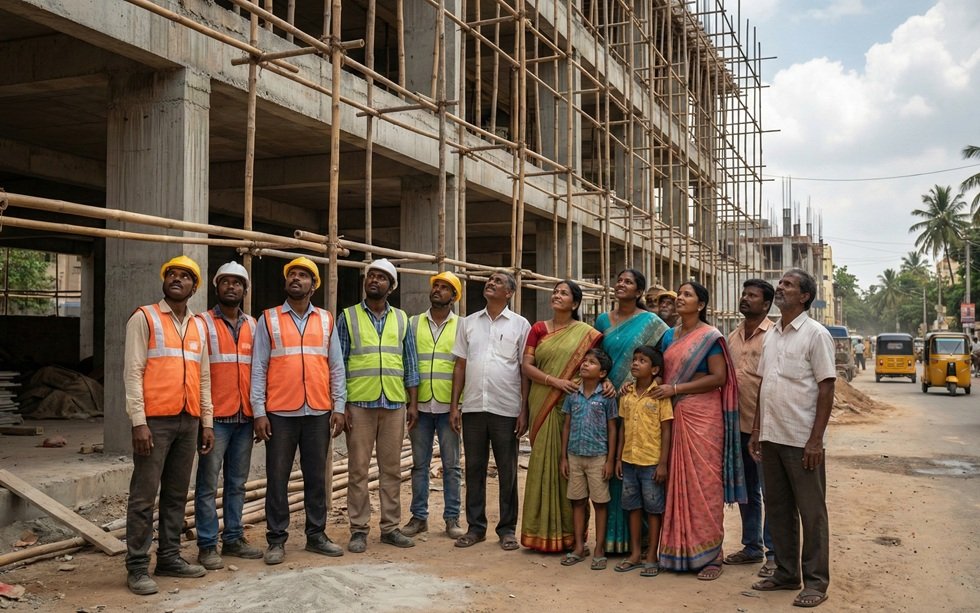
So, which is the best month to build in Chennai? What are the pros and cons of each season? Here is a complete guide.
The Four Seasons of Construction in Chennai
We can divide Chennai’s construction calendar into four distinct phases:
January – March: The Golden Period (Best time to start).
April – June: The Summer Challenge (Critical for curing).
July – September: The Windy Season (Time to speed up).
October – December: The Monsoon (The time to be cautious or pause).
Let’s look at these in detail.
1. January to March: The “Golden Period”
The period between January (Thai) and March is the absolute best time to break ground in Chennai. There are several reasons why we call this the Golden Period:
Climate Advantage: The weather is moderate, and the skies are clear. As the proverb goes, “Thai pirandhal vazhi pirakkum” (The birth of Thai opens new avenues)—this is practically true for construction. The monsoon has passed, so the groundwater table is stable, yet the soil is dry enough for excavation.
Soil Conditions: Many parts of Chennai have clay soil. In the rain, clay becomes slippery; in peak summer, it becomes rock-hard. However, in Jan-Feb, the soil moisture is perfect, making digging easy. There is no risk of pits flooding, ensuring the foundation concrete work proceeds without interruption.
Labor Availability: After the Pongal festival, skilled laborers return from the southern districts to Chennai. Construction sites are fully staffed and buzz with activity.
Cost Benefits: The Central Budget is usually presented in March, after which the prices of cement and steel often rise. Starting in January allows you to purchase materials at current rates, saving money.
2. April to June: The Summer Sprint
During the Agni Nakshatram (peak summer) months of April through June, can you build? Absolutely. Since there is no rain, work proceeds at “jet speed.” It is the best time for rapid brickwork and roofing. However, you must handle two challenges:
The Curing Challenge: Due to high heat, the moisture in fresh concrete evaporates quickly, leading to cracks. You must water the structure (curing) twice as much as usual. It is essential to wrap pillars and roof slabs in wet jute/gunny bags to retain moisture.
Water Scarcity: Chennai often faces water shortages in summer. You may need to buy water via tankers, adding to your budget.
Borewell Strategy: This is actually the best time to drill a borewell. If you find water when the water table is at its lowest, your well will likely never run dry during the rest of the year.
Labor Health: The intense heat makes it difficult for workers to toil during midday, which may slightly alter work shifts.
3. July to September: The Windy Transition
As the month of Aadi begins, strong winds and light drizzles (Southwest Monsoon) arrive.
Structural Work: It is better to avoid digging a new foundation now. However, if the foundation is done, this is the perfect time to raise the superstructure.
Plastering: With reduced heat, this is excellent for plastering walls, as they are less likely to crack.
Myth vs. Reality: Locally, people hesitate to start new ventures in Aadi. From an engineering perspective, this is merely a superstition. In fact, cement prices often drop during this pre-monsoon dip in demand, which you can use to your advantage.
The Goal: It is critical to finish external plastering and the roof slab before October to ensure the building is watertight before the heavy rains.
4. October to December: The Red Zone
This is the Northeast Monsoon season. Heavy rains, cyclones, and flooding are common. Do not dig a new foundation during these months.
Soil Collapse: Rainwater can flood excavation pits, causing the loose earth to collapse. This is dangerous for workers and causes delays. Pumping water out requires motors, adding unnecessary costs.
Material Wastage: Cement bags can spoil due to moisture, and sand can wash away.
Quality Risk: Pouring concrete during rain disrupts the water-cement ratio, weakening the building’s structural integrity.
What CAN you do? If the building is already roofed, focus on interior work: Tiles/Flooring, Plumbing, Electrical wiring, and Carpentry.
Avoid: Do not do painting work. High humidity prevents paint from sticking properly, resulting in a patchy finish.
The Ideal Construction Timeline (For a 2000 sq. ft. House)
If you plan to complete a house in roughly 10 months, here is the perfect schedule:
Oct – Dec: Planning, Drawings, Bank Loans, and CMDA/DTCP Approvals. (Get the paperwork done during the rains).
Jan (Thai): Bhoomi Pooja, Borewell, and Start Foundation.
Feb – Mar: Complete Foundation and Plinth Beam.
Apr – Jun: Wall construction and Roof Concrete (Focus on Curing).
Jul – Aug: Plastering works.
Sep – Oct: Flooring, Electrical, and Plumbing.
Nov (Rainy Season): Woodwork and Interiors.
Dec – Jan: Painting and Final Finishes.
Next Jan: Housewarming (Grihapravesam)!
Other Key Factors to Consider
1. Sand Scarcity During the monsoon, river sand is hard to get as quarries flood and lorries cannot enter. Prices skyrocket. It is easier to source sand between January and June. While M-Sand is popular now, many still prefer river sand for plastering.
2. Festivals & Holidays
Diwali (Oct/Nov): North Indian workers usually take 15 days of leave.
Pongal (Jan): Local Tamil workers take a week off.
Plan your milestones around these breaks.
3. Vastu Shastra For those who follow Vastu, the months of Chithirai, Vaikasi, Aavani, Karthigai, and Thai are considered auspicious for Bhoomi Pooja (ground-breaking). Margazhi and Aadi are typically avoided for starting new work.
To summarize: January is the wisest time to start building a house in Chennai.
The smart strategy is to start in January and complete all exterior work by September. Starting a foundation in the rainy season is like a non-swimmer jumping into a flood. Starting in summer is safe, provided you manage water and curing carefully.
A house is not just stone and soil; it is your dream. To make that dream a reality, work with nature, not against it. Start at the right time, and success is guaranteed!
www.thaliconnect.in