Concrete Jacketing is one of the most established and reliable techniques in structural retrofitting. It involves adding a new layer of reinforced concrete around an existing structural member—typically a column, beam, or wall—to increase its size, strength, and durability.
Think of it as putting a thick, protective cast around a broken or weak bone, but permanently. The “jacket” binds with the original member to function as a single, stronger unit.
Here is an elaborate breakdown of the process, the science behind it, and exactly who needs this service.
1. The Engineering Objective
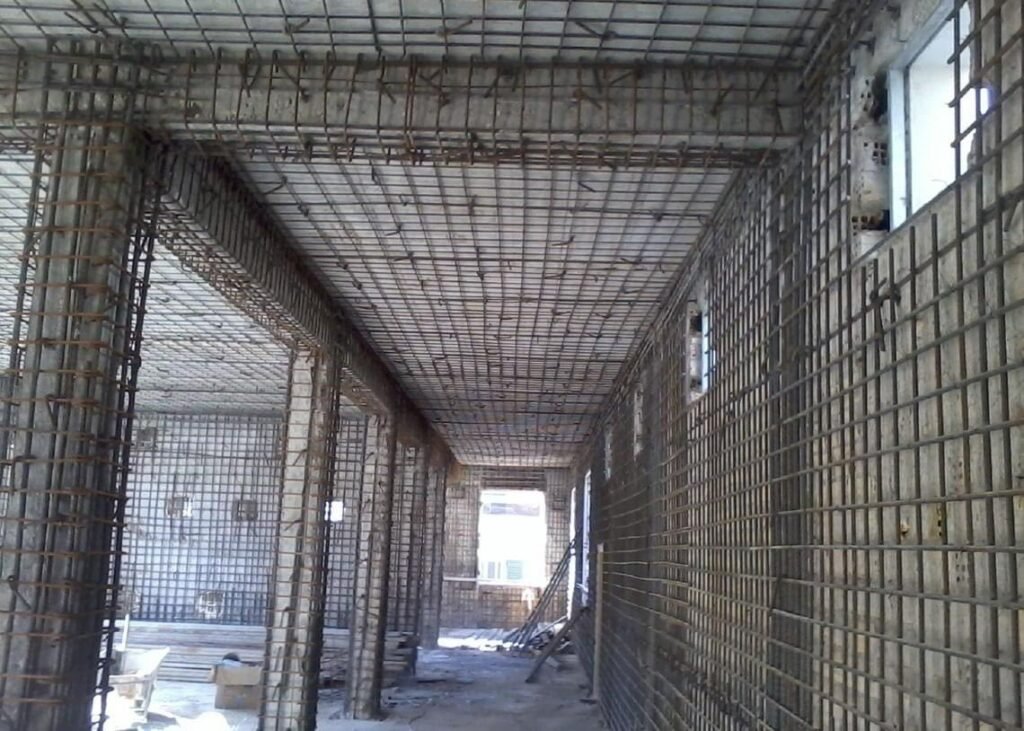
The primary goal of jacketing is to increase the axial load-carrying capacity (ability to hold vertical weight) and stiffness of a structure.
Increase in Size: The cross-sectional area of the column or beam is increased.
Confinement: The new steel stirrups (rings) confine the old concrete, preventing it from bursting under pressure.
Corrosion Protection: It seals off old, damaged concrete from further environmental attack.
2. The Step-by-Step Execution Process
Concrete jacketing is labor-intensive and requires precision. If the bond between the old and new concrete fails, the jacket is useless.
Step A: Surface Preparation (The most critical step)
Relieving Load: Before starting, temporary props (jacks) are often placed to take the weight off the column.
Chipping: The existing plaster and the smooth cover of the concrete are chipped away to expose the rough aggregate (stones) inside. This roughness is vital for the new concrete to grip.
Cleaning: The surface is cleaned with wire brushes or compressed air to remove dust.
Step B: Anchoring (Shear Keys)
Holes are drilled into the existing column.
Steel connectors (dowels) or “shear keys” are inserted and fixed with strong epoxy chemicals. These act like nails, locking the new jacket to the old column so they don’t slide against each other.
Step C: Reinforcement Caging
New vertical steel bars are placed around the column.
New stirrups (rings) are tied closely together to hold the vertical bars. This steel cage provides the tensile strength.
Step D: Bonding Agent
Just before pouring the new concrete, a bonding agent (often an epoxy resin or polymer-modified cement slurry) is applied to the old surface to glue the old and new layers together.
Step E: Shuttering and Concreting
Watertight formwork (shuttering) is placed around the cage.
Micro-Concrete: Because the gap for the jacket is usually small (only 3 to 4 inches), standard concrete with large stones cannot flow through. Instead, “Micro-Concrete” (a flowable, non-shrink, high-strength grout) is poured or pumped in to fill every void without air pockets.
3. Who Needs This Service? (The Target Audience)
Concrete jacketing is not for general cosmetic renovation. It is a serious structural intervention required by specific groups of people facing specific problems:
A. Homeowners Planning Vertical Expansion
The Scenario: You have a Ground + 1 floor house. You now want to build a 2nd and 3rd floor for rental income or family expansion.
The Problem: The original foundation and columns were only designed to hold two floors. Adding more weight will crush them.
The Solution: Jacketing the ground floor columns increases their capacity to support the new floors above.
B. Owners of Aging/Dilapidated Buildings
The Scenario: A building is 30–50 years old. The concrete is spalling (falling off), and the steel bars inside are visible and rusted.
The Problem: The steel has lost diameter due to rust, and the concrete has lost strength due to carbonation. The building is unsafe.
The Solution: Jacketing restores the lost strength and seals the steel from further rusting, extending the building’s life by another 15–20 years.
C. Property Investors Changing Building Use
The Scenario: An old residential house is being converted into a school, a gym, or a library.
The Problem: Residential floors are designed for light loads (2 kN/m²). Commercial spaces, especially libraries or gyms with heavy equipment, require much higher load capacity (4–5 kN/m²).
The Solution: Beams and columns are jacketed to handle the heavier “Live Load.”
D. Buildings in Earthquake Zones (Seismic Retrofitting)
The Scenario: An older building was constructed before modern seismic codes (earthquake rules) were enforced.
The Problem: The columns lack the ductility (flexibility) to survive a tremor and might snap.
The Solution: Jacketing, specifically focusing on adding tight stirrups (confinement), ensures the building sways rather than collapses during an earthquake.
E. Rectifying Construction Blunders
The Scenario: A contractor poured concrete for columns, but lab tests later revealed the concrete strength was Grade M20 instead of the required Grade M30.
The Problem: The building is structurally deficient from day one.
The Solution: Engineers may prescribe jacketing to compensate for the lower concrete strength without demolishing the structure.
4. Pros and Cons Summary
| Advantages | Disadvantages |
| High Strength: Can double the load capacity of a column. | Loss of Space: Increases column size, reducing carpet area. |
| Fire Resistance: Concrete is naturally fireproof (unlike steel plating). | Messy Work: Involves chipping and wet concrete inside a house. |
| Monolithic: If done right, it behaves like a solid, single unit. | Labor Intensive: Requires skilled labor for rebar and shuttering. |
| No Maintenance: Once painted, it requires zero upkeep. | Curing Time: Requires water curing (unless chemicals are used). |
Conclusion
Concrete jacketing is the “heavy lifting” champion of the retrofitting world. If you are a building owner looking to add floors or save a dying building, this is likely the service you need. It turns a weak, skeleton-like structure into a robust, muscle-bound fortress.