Chennai: Whenever the scorching summer sets in, the first fear that grips the minds of Chennaiites is the dreaded ‘water scarcity’. The harrowing memories of waiting for water tankers with empty plastic pots, and the severe crisis of 2019—when groundwater tables plummeted, major lakes dried up completely, and drinking water had to be transported to Chennai via special trains—are still fresh in the city’s collective conscience. At a time when the future of a metropolitan city heavily reliant solely on the monsoons seemed questionable, revolutionary projects began to gather momentum to convert nature’s greatest gift to the city—the ocean—into a reliable drinking water source.
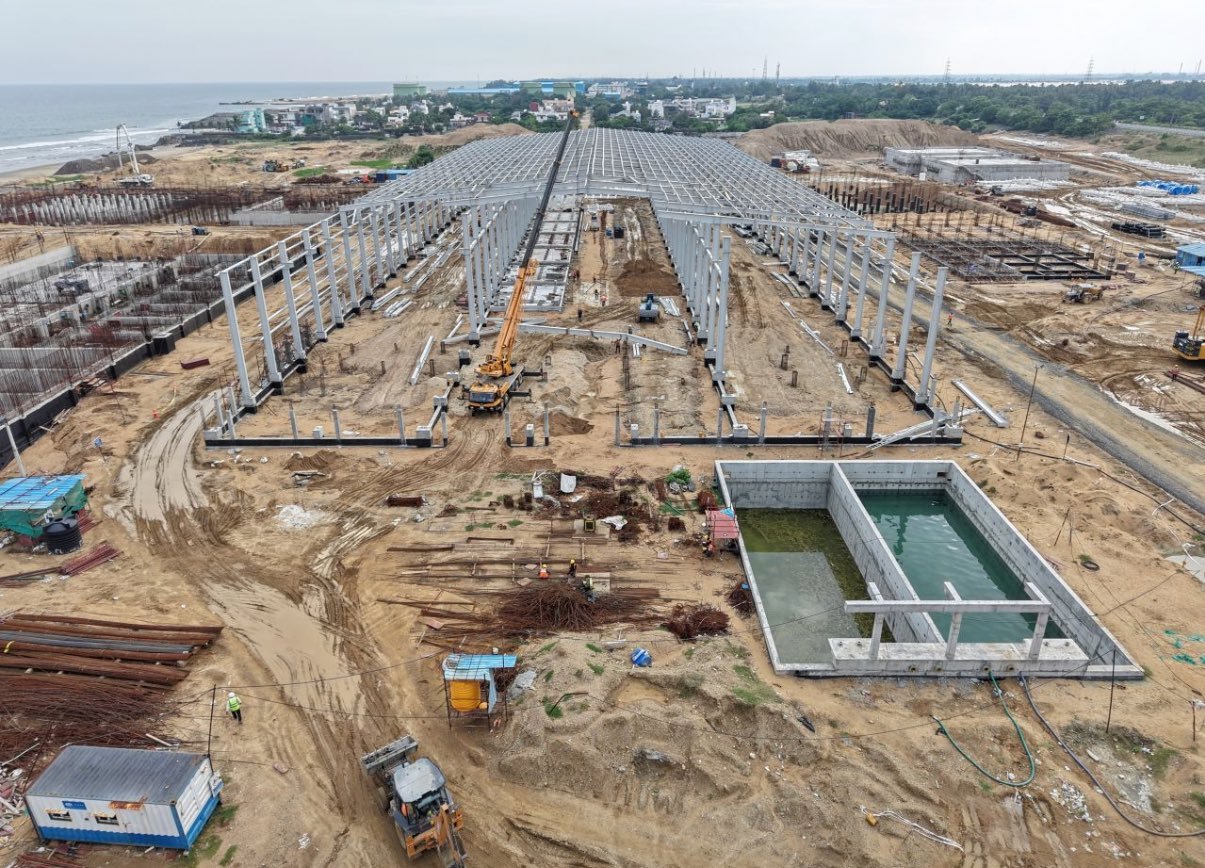
In a massive stride toward ensuring Chennai’s water security for the next 50 years, South East Asia’s largest seawater desalination plant is currently being constructed at breakneck speed in Perur, near Thiruporur in the Chengalpattu district.
Constructed at a staggering estimated cost of ₹6,078.40 crore, this facility is designed to purify 400 Million Liters per Day (400 MLD) of seawater into fresh, potable water. This is not merely an infrastructure project; it is a life-saving elixir designed to protect Chennai’s primary lifeline. Let us take a comprehensive, professional deep-dive into the background of this mammoth project, the mind-boggling engineering technologies involved, the specific neighborhoods that will benefit, and the current status of the construction.
Chennai’s Water Demand and the Desalination Journey
The population of the Chennai metropolitan area and its sprawling suburbs is multiplying by the day. Currently, the city requires approximately 1,230 Million Liters per Day (MLD) of drinking water. Historically, the residents have relied heavily on a network of key rain-fed lakes: Poondi, Cholavaram, Red Hills (Puzhal), Chembarambakkam, Kannankottai-Thervoy Kandigai, and Veeranam. However, whenever the monsoons fail, these lakes inevitably run dry. To eliminate this dangerous unpredictability, tapping into the ocean was proposed as a permanent solution for the coastal metropolis.
Tamil Nadu holds the proud distinction of being the pioneer in successfully implementing large-scale seawater desalination projects in India. The first plant, with a capacity of 100 MLD, was commissioned in Minjur (North Chennai) in 2010. This was followed by a second 100 MLD plant in Nemmeli, along the East Coast Road, in 2013. Subsequently, a third plant with an additional capacity of 150 MLD was also established in Nemmeli. Continuing this aggressive expansion, the fourth and most ambitious project—the 400 MLD plant at Perur—was initiated with the grand vision of meeting exactly half of Chennai’s total drinking water needs entirely through desalinated seawater.
A South East Asian Behemoth: Funding and Consortium
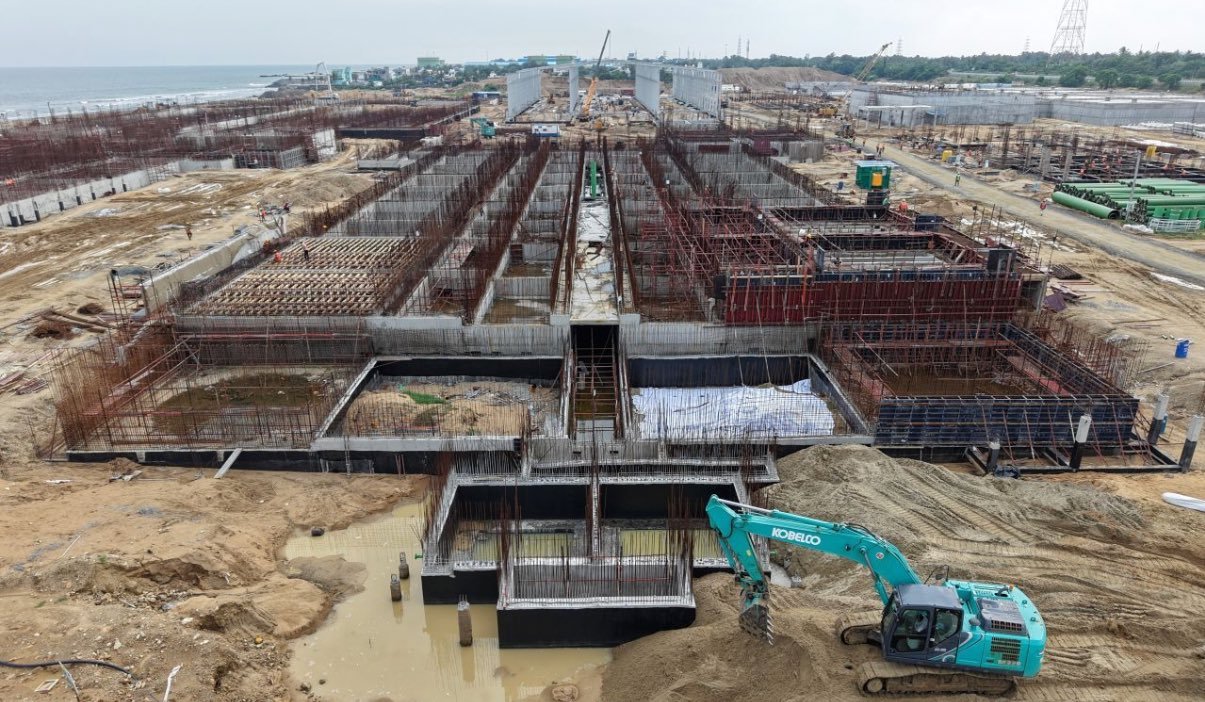
The total valuation of this monumental project stands at ₹6,078.40 crore. To fund an endeavor of this magnitude, financial assistance is being provided by the Japan International Cooperation Agency (JICA). Executed under the direct supervision of the Chennai Metropolitan Water Supply and Sewerage Board (CMWSSB), the massive Design, Build, Operate (DBO) contract—which includes operating and maintaining the plant for the next 20 years—was bagged by a joint venture between the world-renowned water management firm ‘VA Tech WABAG’ and ‘Metito Overseas’ for approximately ₹4,400 crore. Furthermore, the Australian firm ‘SMEC’ has been appointed as the Project Management Consultant to meticulously oversee the construction works.
The foundation stone for this project was laid by the Chief Minister of Tamil Nadu, M.K. Stalin, on August 21, 2023. Since that day, work has been progressing on a war footing, round the clock. Upon completion, the Chennai metropolis will boast an unmatched combined desalination capacity of 750 MLD, officially crowning it as the ‘Desalination Capital of India’.
An Underwater Marine Engineering Marvel
Building a factory on solid ground is one thing; laying massive pipelines deep under the ocean is an entirely different beast. The offshore construction works of this plant are being executed by overcoming terrifying challenges like roaring waves, powerful ocean currents, and highly corrosive sea winds.
The first and most critical task of the plant is to draw pristine seawater from the deep ocean. For this purpose, a 10-meter deep trench was excavated into the seabed to lay mammoth High-Density Polyethylene (HDPE) pipes, each boasting a staggering diameter of 2500 mm (2.5 meters). Two massive intake pipelines—one 1,140 meters long and the other 1,150 meters long—have been successfully pushed into the ocean depths. This marks the very first time in India that intake pipes of this colossal scale have been laid under the sea.
Similarly, to safely discharge the highly concentrated saltwater (brine) back into the ocean after the purification process, another massive pipeline measuring 756 meters in length has been laid. Utilizing cutting-edge satellite technologies such as DGPS and RTK (Real-Time Kinematic), engineers managed to lower these pipes into the seabed with millimeter-level precision, even amidst the fury of the ocean waves. This incredible feat by WABAG’s engineering team has garnered widespread global appreciation.
How Seawater Transforms into Drinking Water (Cutting-Edge Technology)
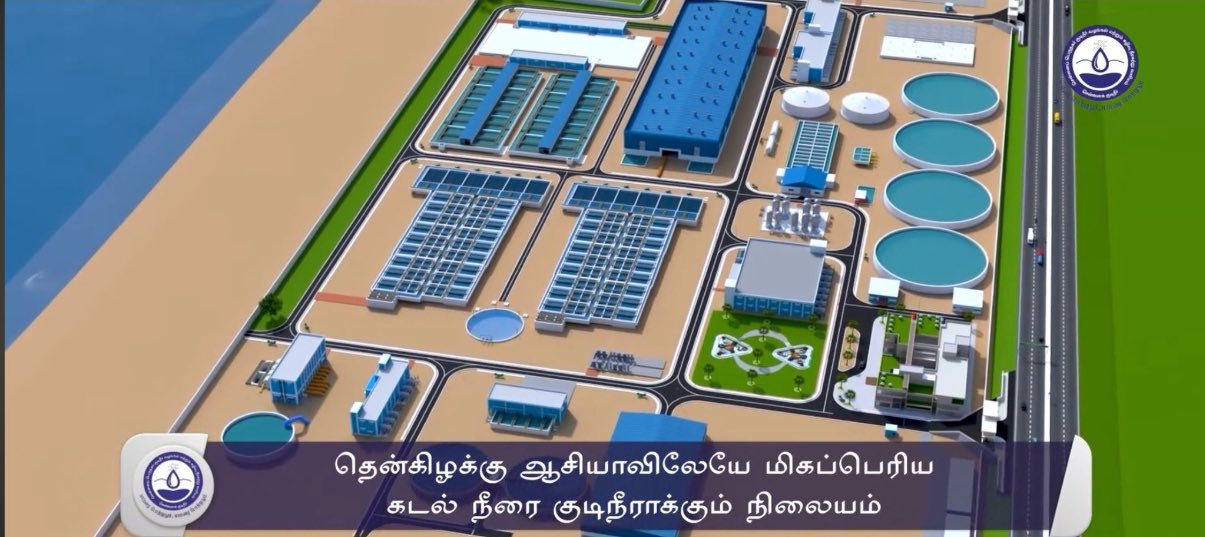
Water drawn from the sea does not magically become drinkable instantly; it must pass through a highly complex, multi-stage purification process. The Perur plant integrates some of the most advanced water treatment technologies available in the world today.
First, the raw seawater is brought into massive holding tanks known as ‘Caissons’, where large floating debris, algae, and solid waste are screened and filtered out. Following this, the water undergoes an intense pre-treatment phase utilizing Dissolved Air Flotation (DAF) and Gravity Dual Media Filters. These advanced systems completely eradicate invisible micro-pollutants, organic matter, and suspended solids. The pre-treatment facilities in the Perur plant are significantly more sophisticated than those in the older plants.
Once pre-treated, the actual core purification begins. Using the Reverse Osmosis (RO) method, the water is forced through microscopic semi-permeable membranes under extremely high pressure. This process entirely strips the salt from the seawater, yielding pure, pristine freshwater. To ensure uninterrupted supply even during maintenance shutdowns, the RO system is designed to operate in two independent streams of 200 MLD each.
Because desalinated water is stripped of all minerals, it must be conditioned to be tasty and healthy for human consumption. In the final ‘Re-mineralisation’ stage, essential minerals are scientifically reintroduced into the water using limestone filters. Only after this rigorous process is the water deemed ready for public distribution.
The 59-Kilometer Distribution Network: Who Gets the Water?
Transporting the purified freshwater to the public is the next colossal challenge. To bring the water from Perur into the heart of Chennai, giant Mild Steel (MS) pipes, spanning a distance of 59 kilometers, are currently being laid. These pipes, with diameters of 2000 mm and 1800 mm, will carry the water to a massive new pumping station being constructed in Porur. To facilitate this, a gigantic 15-million-liter underground water storage reservoir is being built at the Porur site.
From this strategic hub, the water will be distributed across various parts of the Chennai metropolis. Specifically, the beneficiaries will include neighborhoods in the Adyar zone like Pallipattu and Thiruvanmiyur, newly expanded zones of the Chennai Corporation, and the bustling IT Corridor. Furthermore, the entire southern suburban belt—encompassing the Tambaram Corporation limits, Pammal, Polichalur, parts of Pallavaram, Madambakkam, Sembakkam, Chitlapakkam, Peerkankaranai, and Perungalathur—will receive uninterrupted drinking water from this plant.
In total, an estimated 22.67 lakh people will directly benefit from this single desalination facility. Complementing this mega-project, the Water Board is simultaneously executing a massive overhaul by replacing approximately 1,300 kilometers of aging water pipes across the city. This will prevent leakages and ensure that water reaches every household with full pressure.
Environmental Protection and Fishermen Welfare
A primary criticism raised by environmentalists regarding desalination projects is that the dense, highly saline wastewater (brine) discharged back into the sea can severely harm marine ecosystems. However, the Perur plant has implemented a brilliant engineered solution to mitigate this.
Instead of dumping the brine in one concentrated location, the discharge is managed using a network of ‘Diffusers’. These multi-ported structures ensure rapid Brine Dispersion, allowing the saltwater to mix quickly and seamlessly with the deep ocean currents. This prevents any localized alteration of the ocean’s natural salinity. Additionally, to ensure that juvenile fish and other marine life are not sucked into the intake pipes, the plant operates at a very low intake velocity and utilizes specialized screening systems. Officials have assured that all guidelines set by the Tamil Nadu Pollution Control Board (TNPCB) and the Coastal Regulation Zone (CRZ) are strictly adhered to and continuously monitored.
Furthermore, acknowledging the potential disruption to the livelihoods of approximately 170 local fishermen families in the vicinity of the construction, the government has been diligently providing them with monthly compensation—setting a commendable benchmark for corporate and governmental social responsibility.
Current Status: When Will It Open for Public Use?
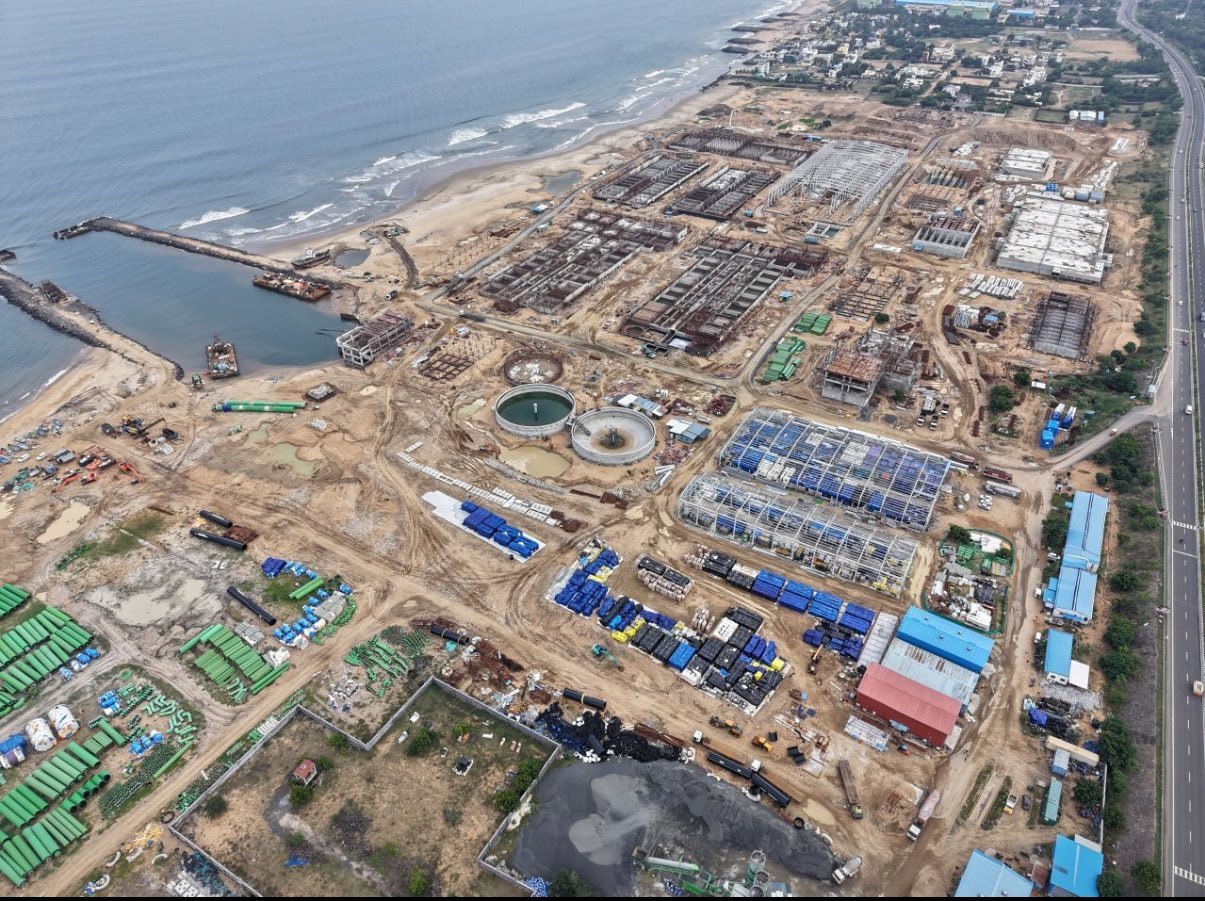
Given the critical importance of this project, the Minister for Municipal Administration and Water Supply, K.N. Nehru, conducts frequent on-site inspections to expedite the work. According to the latest updates from officials, the most challenging offshore marine works were successfully concluded over the past few months, bringing the overall construction completion rate to well over 62 percent.
Major onshore structures—including the seawater intake pump house, Lamella clarifiers, the colossal RO building, the product water tank, sludge thickeners, and the chemical/electrical control rooms—are swiftly reaching their final stages. On the distribution front, of the 19.5 kilometers of pipes that have arrived at the site for the Porur line, over 4 kilometers have already been successfully laid.
If the pace of the work continues as planned, all civil and mechanical construction will wrap up by September 2026, marking the beginning of the plant’s ‘Trial Run’ or commissioning phase. Following rigorous testing protocols, the Managing Director of the Chennai Metropolitan Water Board has assured that this phenomenal facility will be fully dedicated to the public by March 2027.
A city that once parched under the relentless sun is now shattering nature’s geographical barriers with the sheer force of technology. Amidst the looming threats of climate change, global warming, and erratic monsoons, the Perur 400 MLD Desalination Project stands as the ultimate manifestation of visionary thinking: “We cannot rely solely on the rain; we must engineer our own alternatives.”
The colossal investment of ₹6,078 crore, backed by the Japanese government, combined with the world-class engineering prowess of multinational consortiums like WABAG and Metito, and the aggressive execution by the Tamil Nadu Government, are converging to effortlessly solve Chennai’s future water demands.
When this plant becomes fully operational in 2027, the taps in Chennai’s IT hubs, sprawling industrial estates, and the homes of over 22 lakh ordinary citizens will flow without interruption. Achieving what no other major metropolis in India has managed to do, Chennai will proudly wear the crown of the ‘Desalination Capital of India’, having successfully transformed the mighty ocean into its own perennial, life-giving river!