When you think of Assam, your mind instantly paints a picture of lush green tea gardens, the majestic one-horned rhinoceros of Kaziranga, and above all, the mighty Brahmaputra River. Flowing with a quiet grace during the dry months, this river transforms into an unstoppable force of nature during the monsoons. For decades, the Brahmaputra hasn’t just been a river; it has been a massive geographical wall, practically splitting Assam—and the Northeast—into two halves, leaving the people on the north and south banks struggling to connect. But the days of bowing down to geographical barriers are over. Human ingenuity and sheer engineering willpower are about to conquer the mighty river. In a historic move, the Government of India has given the green light to construct a magnificent, invisible pathway right beneath the riverbed: India’s first-ever underwater road-cum-rail tunnel. Sanctioned at a staggering ₹18,662 crore, this is not just an infrastructure project; it is a bold statement of a rising India. Let’s dive deep into the fascinating story of how this mammoth project is going to rewrite the map of Northeast India, give nightmares to our hostile neighbors, and turn a grueling six-hour road trip into a breezy 20-minute ride!
Not Over the River, But Under It! Why the Sudden Shift?
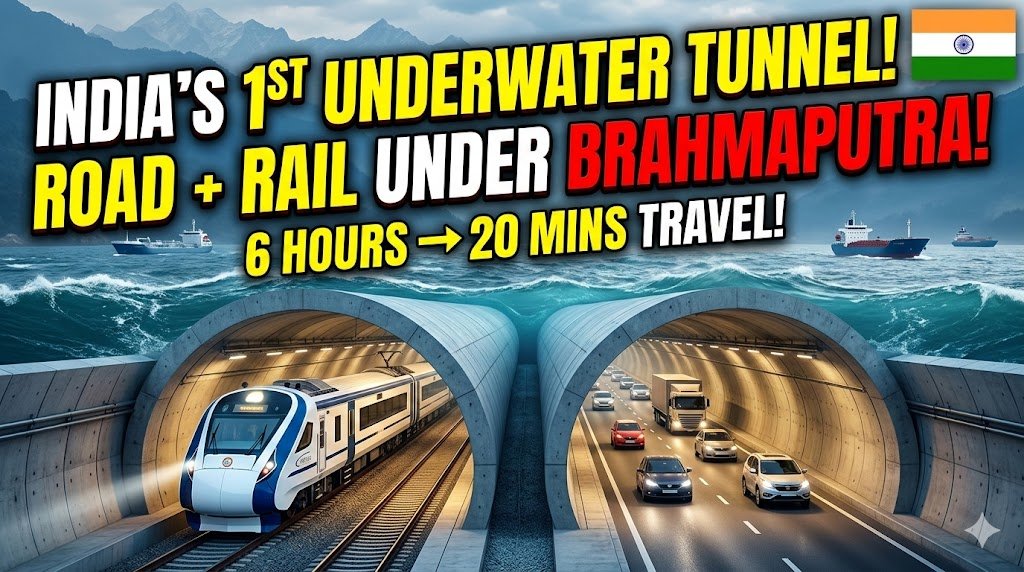
Usually, when we need to cross a river, the answer is simple: build a massive bridge. India has already built several iconic bridges over the Brahmaputra, like the Bogibeel and Kaliabhomora. So, why spend thousands of crores to dig a tunnel beneath the water to connect the towns of Gohpur and Numaligarh? The decision stems from the very nature of the Brahmaputra itself, which is one of the most heavily sediment-laden rivers in the world. During floods, its currents are terrifyingly violent, putting bridges at the mercy of the weather and making travel risky during heavy monsoons. A tunnel sitting 50 meters below the riverbed completely bypasses the storms raging above, guaranteeing safe, all-weather connectivity every single day of the year.
Beyond beating the weather, there is the magic of time travel. Currently, traveling from Gohpur on the north bank to Numaligarh on the south bank requires a massive 240-kilometer detour via the Kaliabhomora bridge, draining away more than six exhausting hours. By punching a straight hole under the river, this sprawling distance will shrink dramatically, reducing the travel time to just 20 to 30 minutes. Most importantly, an underwater tunnel acts as an invisible shield. From the sky, bridges are sitting ducks during an armed conflict, making them easy targets for enemy missiles. A tunnel buried deep beneath thousands of tons of water and earth, however, is practically indestructible and invisible to enemy radars, serving as a covert and highly secure artery for our armed forces.
An Engineering Marvel That Will Make the World Look Twice
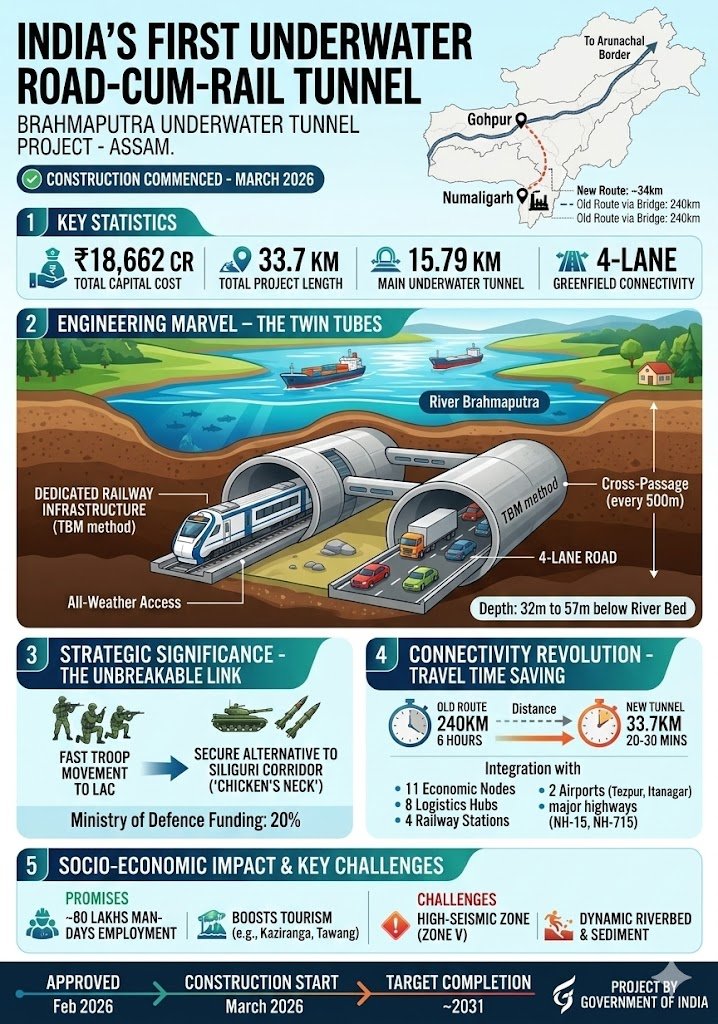
This project is far more complex than simply bringing in a few excavators to dig a trench. It is a world-class engineering spectacle, marking the second of its kind globally and an absolute first for India. The sheer scale of the project is staggering, spanning a total length of 33.7 kilometers. While the approach roads stretch for several kilometers on either side, the main underwater tunnel itself will be a massive 15.79 kilometers long. Driving into it won’t mean entering a single, dark cave. The ingenious design features two separate, massive cylindrical tubes running parallel to each other. One tube will host a state-of-the-art four-lane highway, with two lanes in each direction for cars and trucks. The real shocker, however, is that one of the tubes will also feature dedicated railway tracks. Having cars and trains moving side-by-side, deep underwater, is an unprecedented feat in Indian engineering.
Burrowed at a mind-boggling depth of 32 to 57 meters below the actual riverbed, the tunnel is fortified with bulletproof safety measures. To address natural fears of underwater accidents or fires, engineers have designed emergency cross-passages every 500 meters that connect the two main tubes. If a vehicle breaks down in one tube, people can easily evacuate into the other. Combined with cutting-edge ventilation systems, fire-suppression technology, and round-the-clock CCTV monitoring, this underwater marvel will be safer than most surface highways.
Taming the Dragon – The Ultimate Military Masterstroke
The moment this project was announced, it undoubtedly caused some sleepless nights across the border in China. For years, China has been aggressively posturing near the Line of Actual Control, particularly eyeing Tawang in Arunachal Pradesh. To effectively counter this, the Indian Army desperately needed a rapid, foolproof transit route. Currently, the Northeast is connected to the rest of India by a highly vulnerable, 22-kilometer-wide strip of land known as the Siliguri Corridor, often referred to as the “Chicken’s Neck.” If an adversary manages to choke this narrow corridor during a war, the entire Northeast could be isolated.
The Gohpur-Numaligarh underwater tunnel serves as the ultimate countermeasure to this strategic vulnerability. In times of crisis, heavy artillery, tanks, ballistic missiles, and thousands of troops stationed in Assam can be transported silently and swiftly to the Arunachal Pradesh border in a matter of hours. Recognizing this immense strategic value, the Ministry of Defence has stepped in to fund a massive 20 percent of the project’s total cost. This transforms the tunnel from a mere transport link into a fortified lifeline for India’s national security.
The Mechanical Earthworms & The Earthquake Challenge
Digging a 15-kilometer tunnel under a massive river without the water crashing down requires machinery of epic proportions. Engineers will deploy mechanical leviathans known as Tunnel Boring Machines, or TBMs, to execute this delicate task. A TBM operates like a gigantic, metal earthworm. Its front features a massive, rotating cutter head equipped with titanium teeth that relentlessly grind through soil and bedrock. As it slowly chews its way forward, an internal conveyor belt carries the excavated muck out to the surface.
The true magic of the TBM lies in its ability to build while it digs. As the machine edges forward, its robotic arms instantly place pre-cast, heavy-duty concrete segments behind it, forming the tunnel’s walls in real-time. By the time the machine moves along, it leaves behind a fully finished, waterproof concrete ring. This process is particularly crucial because Assam sits in Seismic Zone V, one of the most earthquake-prone regions on earth. Building a rigid tunnel here would be a catastrophic mistake. To counter the tremors, the concrete segments will be bound together using highly specialized, flexible rubberized joints. If a massive earthquake strikes, the tunnel won’t snap; instead, it will flex and sway like a bamboo stalk, keeping everyone inside perfectly safe.
The Economic Engine & The Tourism Boom
While the military benefits are undoubtedly massive, the civilian and socio-economic impact of this tunnel will completely revolutionize the Northeast region. Numaligarh on the south bank is already an industrial powerhouse, home to a massive oil refinery, while Gohpur on the north bank acts as a gateway to the agricultural heartlands. By slashing the travel distance from 240 kilometers to just 33 kilometers, thousands of supply trucks will save millions of liters of diesel every year. This massive drop in logistics costs will cause the prices of transported goods, from tea to petroleum, to plummet, thereby supercharging the local economy.
Furthermore, the project is a masterclass in multi-modal connectivity. It seamlessly integrates two major National Highways, NH-15 and NH-715, while linking up with the Rangia-Mukongselek and Furkating-Mariani railway lines. It also connects to eleven major economic nodes and provides incredibly fast access to airports in Tezpur and Itanagar. For the tourism sector, this tunnel is an absolute dream come true. The world-famous Kaziranga National Park is located just a stone’s throw from Numaligarh. Once the tunnel is operational, tourists exploring the snow-capped peaks of Arunachal Pradesh can zip down through the tunnel and go on a rhino safari in Kaziranga on the very same day. This newfound ease of travel is expected to trigger an unprecedented boom in hotels, restaurants, and local businesses. As an added bonus, the government estimates that the construction phase alone will generate over 80 lakh man-days of employment, injecting massive wealth directly into the hands of the local population.
The Unstoppable Rise of a New India
When we think of grand underwater tunnels, our minds usually drift to the Channel Tunnel connecting the UK and France. But today, Indian engineers are scripting their own legacy, attempting a feat so audacious that the global engineering community is watching with bated breath. The Brahmaputra has flowed for millennia, acting as a silent witness to the rise and fall of empires. By the estimated completion year of 2031, it will witness something entirely new: the indomitable spirit of a modern India.
The day is not far when you will drive your car down a gentle slope in Gohpur, enter a brightly lit, state-of-the-art concrete tube, and just 20 minutes later, emerge in Numaligarh, completely defying the raging waters above. This ₹18,662 crore marvel is not just a tunnel; it is an unbreakable bond tying the Northeast closer to the heart of India, a nightmare for our adversaries, and a shining beacon of India’s infrastructural prowess!