In the bustling construction landscape of Chennai—from the sandy soils of ECR to the clay-heavy belts of Velachery and the rocky terrains of Chromepet—every prospective homeowner faces the same pivotal decision: “Should I give the project on a Material Contract (Turnkey) or just a Labour Contract?”
As a civil engineer who has walked countless sites in this city, I hear this question daily. Usually, it stems from a simple, often misleading calculation. You sit with a calculator and think, “The builder is charging ₹2,300 per sq. ft. But if I buy the cement and steel myself, surely I can build it for ₹1,800.”
This article is a deep dive into that assumption. We will strip away the marketing gloss and look at the raw mechanics of construction in Chennai as of early 2026. We will explore the hidden costs, the logistical nightmares, the psychological toll, and the actual financial differences between managing a Labour Contract yourself versus handing over the keys via a Material Contract. This is not just about money; it is about the value of your time, the quality of your structure, and the safety of your investment.
Part 1: The Labour Contract (The “Hands-On” Model)
1.1 Definition and Scope
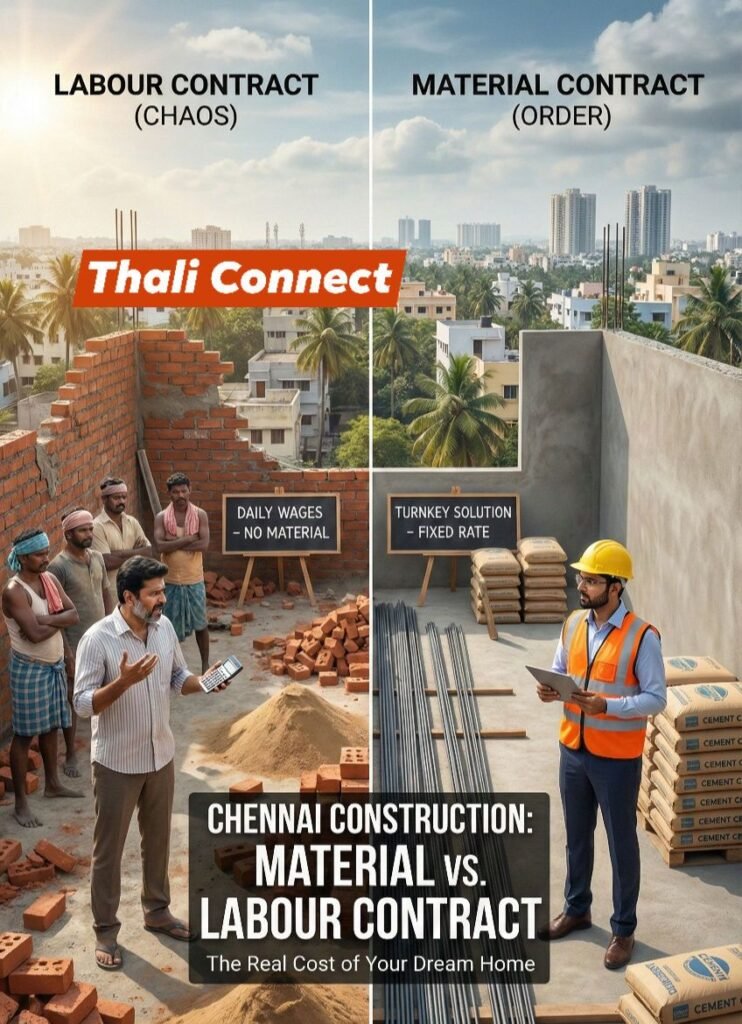
In a Labour Contract, you (the owner) are effectively the General Contractor. You hire a “Maistry” (Head Mason) or a small-time labour contractor who provides the workforce—masons, helpers, and barbenders. You, however, are responsible for procuring every single material: from the 500 bags of cement down to the binding wire and the nails for the centering sheets. The contractor charges you strictly for the human effort, usually calculated per square foot of the “roof slab area.”
1.2 The Rates: The 2026 Chennai Reality
As of January 2026, the market rate for a Labour Contract in Chennai for a standard residential RCC structure ranges between ₹350 to ₹500 per sq. ft.
Basic Structure (Skeleton): ₹350 – ₹380 per sq. ft.
With Finishing (Plastering, Flooring labour): ₹420 – ₹500 per sq. ft.
On the surface, this looks attractive. For a 1,000 sq. ft. house, you think you are paying only ₹4-5 Lakhs to the contractor. You assume the materials will cost another ₹10-12 Lakhs, bringing the total to ₹17 Lakhs—far cheaper than the ₹23 Lakhs a builder might quote. This is the “Trap of the Visible Cost.”
1.3 The Hidden Logistics: The Job You Didn’t Apply For
When you choose a Labour Contract, you are not just “buying materials.” You are taking on a full-time job as a Procurement Manager, Logistics Officer, and Quality Control Engineer.
The Supply Chain Struggle: In Chennai, sourcing river sand is currently a geopolitical nightmare. You cannot just order it; you need contacts. If you opt for M-Sand (Manufactured Sand), which is the standard now (approx. ₹55-65/cft), you must ensure you aren’t getting “dust” passed off as washing sand. A builder has a trusted supplier; you will be testing new vendors who might cheat on volume (a “unit” that is 90 cft instead of 100 cft).
The “Just-in-Time” Headache: Your Maistry will call you at 7:00 AM saying, “Sir, cement is over. Work will stop in 1 hour.” You have to rush to the hardware store, negotiate, and arrange transport. If the truck breaks down or the shop is closed, 10 labourers sit idle. You still have to pay their “batta” (daily allowance) or risk them leaving for another site.
Water & Electricity: In areas like OMR or Tambaram where groundwater might be scarce or unfit for curing, you are responsible for buying lorry water. A builder factors this into their overhead; for you, it’s a daily cash outflow of ₹800-₹1,500 that you didn’t budget for.
1.4 The Wastage and Theft Factor
This is the single biggest leak in a Labour Contract.
Wastage: A labour contractor has no incentive to save your cement. If the mix ratio is 1:5, they might use 1:4 just to make the work “easier” or “stronger” without understanding the structural redundancy. They will cut steel bars inefficiently, leaving you with piles of useless scrap rods.
Theft: It is an unfortunate reality in unmonitored sites. Bags of cement, steel rods, and electrical coils vanish overnight. In a Material Contract, this loss is the builder’s problem. In a Labour Contract, every stolen bag is a direct hit to your wallet.
Part 2: The Material Contract (The “Turnkey” Model)
2.1 Definition and Scope
In a Material Contract, you sign an agreement with a Builder or Civil Engineering firm to deliver a finished house for a fixed rate per square foot. The builder handles everything: design, structural drawings, material procurement, labour management, government liaising (often), and technical supervision.
2.2 The Rates: The 2026 Chennai Tiers
As of early 2026, reputable builders in Chennai quote in these brackets:
Budget/Economy: ₹2,100 – ₹2,300 per sq. ft. (Uses M-Sand, localized tiles, basic fittings).
Standard/Premium: ₹2,400 – ₹2,700 per sq. ft. (River sand for plastering, Teak wood main door, branded tiles like Kajaria/Somany, equivalent to typical middle-class expectations).
Luxury: ₹2,800 – ₹3,500+ per sq. ft. (Italian marble, high-end automation, premium sanitary ware like Kohler/Toto).
2.3 The “Builder’s Advantage”
Why does the builder charge ₹2,400 when you calculated ₹1,800?
Economies of Scale: I buy cement in bulk (500+ bags) directly from the factory or a prime distributor. I get a bag for ₹360 when you pay ₹440 at the retail shop. I buy steel by the ton with a trade discount.
Credit Rotation: Construction is cash-heavy. Builders have credit lines with suppliers. When you run out of cash mid-month, work stops. When I run out of cash, I use my credit account to keep the site moving.
Technical Accountability: If the roof leaks, you have a legal contract to hold me liable. In a Labour Contract, the Maistry will blame the cement quality, and the cement shop will blame the mason’s mixing. You are left with a leaking roof and no one to sue.
Part 3: Detailed Comparative Analysis
3.1 The Cost Reality: Spreadsheet vs. Site
Let’s break down the cost for a 1,000 sq. ft. Ground Floor house in a suburb like Madipakkam or Porur.
Scenario A: Labour Contract (Self-Managed)
Labour Cost (₹450/sq.ft): ₹4,50,000
Material Costs (Est): ₹14,00,000
Approvals/EB/Water (Owner’s scope): ₹1,50,000
Hidden Costs (The “oops” factor):
Wastage (10%): ₹1,40,000
Theft/Loss: ₹50,000
Price Hikes (Steel/Cement fluctuation): ₹1,00,000
Real Total: ₹22,90,000 (Approx ₹2,290/sq.ft)
Scenario B: Material Contract (Builder)
Agreed Rate (₹2,400/sq.ft): ₹24,00,000
Approvals/EB (Usually extra, say ₹1.5L): ₹1,50,000
Real Total: ₹25,50,000
The Difference: You “save” roughly ₹2.5 Lakhs (approx 10%) by doing it yourself. The Question: Is 12 months of daily stress, leaving your office early, dealing with rough labour, and risking structural quality worth ₹2.5 Lakhs? For a salaried professional earning ₹1 Lakh+ a month, the opportunity cost of your time usually outweighs this saving.
3.2 Quality Control: The Engineering Eye
Labour Contract Risks: The Maistry knows how to lay bricks, but he doesn’t know why we provide a bond beam or the specific cover depth for column steel (40mm). He might place the steel too close to the surface, leading to corrosion (spalling) in 5 years—a common sight in Chennai’s coastal humidity. He might add excess water to the concrete mix because it makes it easier to pour, drastically reducing the concrete’s strength (Water-Cement Ratio violation).
Material Contract Safety: A qualified engineer supervises the site. We use cube tests to check concrete strength. We ensure the steel overlaps are technically correct (50D). We cure the concrete for the required 14-21 days because our reputation depends on it.
3.3 The “Chennai Factors”
The Soil: In areas like Velachery or Pallikaranai, the soil is clayey and prone to settlement. A Labour Contractor might suggest a simple foundation. An engineer will insist on a Pile Foundation or specific soil treatment. Saving money on the foundation in these areas is suicidal.
The Monsoon: Construction in Chennai during Oct-Dec (Northeast Monsoon) is hell. In a Labour Contract, the workers will demand pay even if they sit idle due to rain. A builder absorbs these seasonal risks.
Part 4: The Psychology of Construction
This is rarely discussed but is the most critical aspect.
4.1 The “Saturday Evening” Crisis
In a Labour Contract, every Saturday is payday. You must have cash ready. If you are short by ₹5,000, the labour might not show up on Monday. You deal with their personal loans, their family emergencies, and their disputes. You become their HR manager.
4.2 The Variation Game
“Sir, this cupboard design is difficult, I need extra money.” “Sir, shifting sand to the first floor is hard, I need ‘lifting charges’.” In a Labour Contract, the initial quote is just an entry ticket. The “Extras” never end. In a Material Contract, the specifications are frozen. If I agreed to put a Teak door, I must put a Teak door, regardless of whether the carpenter finds it hard to fit.
4.3 The Blame Game
If the floor tiles crack:
Labour Contract: Mason says “Tiles were cheap quality.” Tile shop says “Mason didn’t put enough cement bedding.” You pay to fix it.
Material Contract: You point to the crack. The builder fixes it. Period.
Part 5: When Should You Choose Which?
Choose a Labour Contract IF:
You are technical: You are a civil engineer, architect, or have deep construction experience.
You have time: You are retired or have a job that allows you to be on-site for 2-3 hours every single morning.
You have local clout: You know the local politicians, the police, and the supplier mafia to handle disruptions.
You are cash-constrained but cash-flow rich: You can’t pay a big advance but can manage weekly payouts.
Choose a Material Contract IF:
You value peace of mind: You want to visit the site on weekends to see progress, not to solve problems.
You live abroad/away: NRIs or those living in other cities must strictly use Material Contracts. Remote-controlling a labour contract is a recipe for disaster.
You want bank loans: Banks prefer detailed agreements with Builders for disbursement.
You want a warranty: Reputable builders offer a structural warranty (usually 10-15 years) and a maintenance period (6-12 months) for leaks/cracks.
Part 6: Critical Clauses for 2026 Contracts
Whether you choose Material or Labour, the paperwork is your only shield.
For Material Contracts:
The Brand List: Do not accept “Equivalent Brand.” Specify: Cement: Ultratech/Coromandel. Steel: Tata/JSW. Wires: Finolex/Polycab.
Escalation Clause: Steel prices in Chennai are volatile (currently ₹65-75/kg). Fix a cap. “Builder bears cost fluctuation up to 5%. Beyond that, owner pays the difference upon proof of invoice.”
Payment Schedule: Never pay more than the work done. A typical schedule: 10% Advance, 10% Plinth, 15% Roof Level, etc. Keep 5% as a “Retention Amount” to be paid 6 months after handover (to ensure they fix minor snags).
For Labour Contracts:
Measurement Mode: Agree on how you measure. Is it “Plinth Area” or “Roof Slab Area”? Roof slab area includes the overhangs (sunshades) and costs you 15-20% more. Clarify this before starting.
Inclusions: clearly list: Curing (watering), Watchman salary, Lifting charges, Scaffolding rental. Usually, Maistries try to push these costs to the owner later.
In 2026, the construction industry in Chennai is becoming more professional but also more complex. The days of the simple “Maistry build” are fading as designs get modern and materials get specialized.
If you are building your “Forever Home”—the place where your children will grow and you will retire—I strongly recommend a Material Contract with a reputable, transparency-focused builder. The 10-15% premium you pay is the cost of insurance against structural failure, legal hassles, and mental exhaustion.
However, if you choose the Material route, your job changes from “Manager” to “Auditor.” Don’t blindly trust. Visit the site. Check the cement brand. Count the steel rods. But let the professional handle the headache of getting them there.
Final Tip: If you are unsure, look for a “Cost Plus” model. This is a hybrid where you pay the actual material bills (transparency) + a fixed engineering fee (approx 15%) to the builder to manage the show. It offers the savings of a labour contract with the expertise of a material contract.
Built on trust, verified by steel.
| Material/Labor | Unit | Current Rate Jan 2026 | Notes |
| Cement (OPC) | Bag (50kg) | 320 – 460 | Volatile, rising trend. Brands like Ultratech/Chettinad around 330-400; higher for premium. |
| Steel (Fe550) | Kg | 48 – 75 | Tata/JSW premium priced around 55-75; lower for generic. |
| M-Sand | Cubic Ft | 40 – 65 | Standard for concrete; varies by quality and supplier. |
| River Sand | Cubic Ft | 65 – 120 | Scarce/regulated; often illegal sourcing noted. Used mainly for plastering. |
| Bricks (Red) | Piece | Chamber/high-quality red clay bricks. | |
| AAC Blocks | Piece | 45 – 105 | Faster, lighter; price varies by size (e.g., 600x200x150mm around 45-68, larger up to 105). Requires skilled handling. |
| Painter Labour | Per Day | 800 – 1000 | Skilled painters; rates may vary by experience and project type. |
| Mason Labour | Per Day | 900 – 1200 | Skilled masons; head mason may command 1000-1500. |
| Helper | Per Day | 600 – 800 | Migrant/local helpers; lower for unskilled. |