A home is not just a brick-and-mortar structure; it is a lifelong dream. But would you believe that a single minor error—specifically in selecting the sand—could potentially halve the lifespan of your future home?
Many of us are still stuck in the nostalgia of the past, believing that because our grandfathers built strong homes using river sand, it remains the superior choice today. However, the harsh reality is that the river sand of that era simply does not exist anymore. Much of what is sold as river sand today contains up to 10% clay and silt, which actively degrades the strength of concrete. Even worse, adulteration with sea sand introduces salts that can slowly corrode the reinforcement steel (rebar) from within your walls.
So, what is the solution? Will using M-Sand cause your house to crack, or is it actually the backbone of modern construction?
This guide aims to clear the confusion for anyone planning to build a quality home. We will look beyond the myth of river sand and analyze how you can build a structurally superior and cost-effective dream home using scientifically proven M-Sand and P-Sand technologies.
The Myth and Reality of River Sand
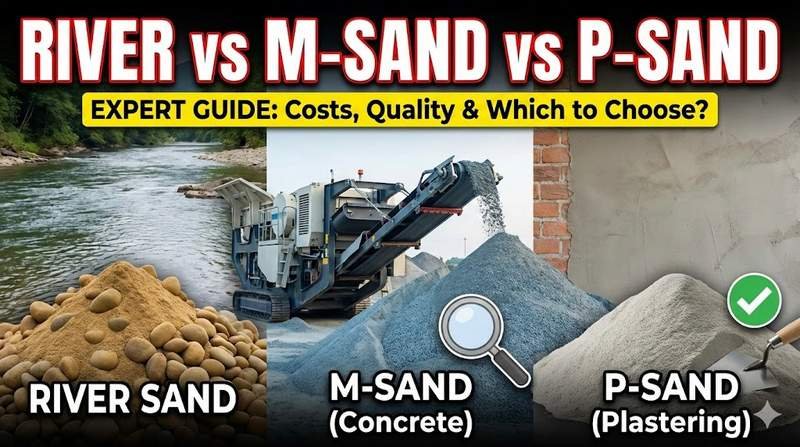
River sand is the result of thousands of years of natural weathering. Rocks break down, roll along riverbeds, collide, and are polished into smooth, rounded particles. Historically, river sand from basins like the Kaveri and Palar in Tamil Nadu was prized for its high silica content and chemical inertness.
Traditionally, its smooth texture made it a favorite among masons. It mixed easily with cement and water, spreading like butter during plastering. Its natural thermal properties also offered good heat resistance.
However, the situation today has turned upside down. The biggest enemy of modern river sand is silt and clay. While high-quality sand should contain less than 3% silt, current supplies often contain up to 10%, which significantly compromises concrete strength. Furthermore, due to environmental regulations and scarcity, much of the available “river sand” is either imported or illegally dredged and adulterated. If sea sand is mixed in, the chloride content will corrode the steel structure, drastically reducing the building’s longevity.
Part 2: M-Sand (Manufactured Sand) – The Backbone of Modern Construction
When nature’s supply dwindles, human innovation takes over. M-Sand is a prime example of this. It is not merely rock dust; it is a meticulously engineered construction material produced by crushing hard granite rocks (blue metal) using Vertical Shaft Impactor (VSI) technology. This process creates cubical particles that are graded to match river sand standards.
Why Engineers Prefer It As a consultant, I can firmly state that for concrete structures—foundations, columns, beams, and slabs—M-Sand is often superior to river sand. While river sand particles are round, M-Sand particles are cubical with rougher edges. When mixed with cement, these edges interlock tightly, resulting in a concrete compressive strength that can be up to 20% higher than that of river sand concrete.
Addressing the Myths There is a common misconception that M-Sand causes cracks or increases heat. This is incorrect. If you use high-quality, water-washed M-Sand, these issues do not arise. However, M-Sand is slightly heavier than river sand and has a higher surface area, meaning it may require marginally more water and cement during mixing. If proper curing (keeping the concrete wet) is neglected, shrinkage cracks may appear, but this is easily manageable with standard construction practices.
Part 3: P-Sand (Plastering Sand) – The Secret to a Smooth Finish
It is crucial not to confuse M-Sand with P-Sand. If M-Sand is the muscle for the structure, P-Sand is the skin for the finish. Produced from the same rock source, P-Sand undergoes a different processing method where it is sieved to a very fine texture (150 microns to 2.36 mm). Excess micro-fines are washed away, giving it a smooth texture similar to river sand.
The Aesthetic Advantage Using rough M-Sand for plastering leads to uneven walls that require excessive wall putty to smooth out. P-Sand, however, spreads thinly and evenly. It is excellent for brickwork, filling the joints between bricks perfectly, and creates an ideal base for tiling. Its primary advantage is the prevention of hairline cracks, which are common in river sand plastering due to organic silt decay.
A Word of Warning: Beware of “Quarry Dust” being sold as P-Sand. Quarry dust is unregulated waste from stone crushing containing excessive fine dust that causes plaster to peel. Always insist on “Washed P-Sand.”
Cost Analysis and Smart Savings
While prices fluctuate based on location, the general trend in Tamil Nadu is clear. River sand is the most expensive option—often costing two to three times more than M-Sand—and comes with the added headaches of availability and potential illegality.
Switching to M-Sand can reduce your sand costs by 40-50% without compromising quality. P-Sand may cost slightly more than M-Sand due to the extra refining, but it remains cheaper than river sand. For a dream home, budgeting is critical; mistakes in sand selection can drain your bank account or, worse, compromise the structural integrity.
Quantity Estimation (Thumb Rules)
To help you budget for a standard 1000 sq. ft. house, here are some engineering thumb rules:
For Concrete Work (Roof Slabs, Beams, Columns) using a standard M20 mix ratio, you will need approximately 4 to 4.5 units (400–450 cubic feet) of M-Sand for the roof slab alone (assuming a 5-inch thickness).
For Brickwork, laying 1000 bricks generally requires about 25 to 30 cubic feet of sand. While M-Sand can be used, P-Sand provides a cleaner finish.
For Plastering, you will need about 2 to 2.5 cubic feet of P-Sand for every 100 sq. ft. of interior walls, and slightly more (3.5 to 4 cubic feet) for exterior walls due to the increased thickness required.
In total, constructing a complete 1000 sq. ft. home typically consumes 20 to 25 units of combined M-Sand and P-Sand.
Field Quality Tests: Be Your Own Quality Control
You don’t always need a lab to check quality. Before the truck dumps the sand, perform these simple on-site tests using just a glass of water and a lemon.
The Glass Jar Test (Silt Check): Fill a glass halfway with sand and add water until it is three-quarters full. Add a pinch of salt, shake well, and let it settle for an hour. If a thick layer of dirt settles on top of the sand, it contains excess silt. For M-Sand, this silt layer should not exceed 8-10% of the total height; for river sand, it must be under 3%. If the water remains very muddy, the sand is likely unwashed.
The Lemon Test (Adulteration Check): Squeeze lemon juice or a drop of acid onto a handful of sand. If it fizzes or foams, the sand likely contains limestone or sea shells, which is dangerous for the building. Good sand will not react.
The Palm Test (Clay Check): Squeeze wet sand in your palm. If it clumps together like a clay ball or sticks to your skin, it has high clay content. Good sand should crumble and fall off cleanly.
The Shape Check: Look at the particles through a magnifying glass. M-Sand should be cubical. If the particles look flaky or elongated, they were processed in a substandard crusher and will result in weaker concrete.
As a construction consultant, my advice is straightforward:
- For Concrete (Structure): Use M-Sand without hesitation. Its strength is unmatched, and it is environmentally responsible.
- For Plastering & Brickwork: Use quality, washed P-Sand for a smooth, crack-free finish.
- For River Sand: Unless you have an unlimited budget and a reliable source, chasing river sand today is unwise. If you must use it, never proceed without a lab test confirming silica and silt levels.
Construction is about using the right material in the right place. By moving away from the illusion of “old is gold” and embracing scientific advancements like M-Sand and P-Sand, you ensure your home is not only cost-effective but built to last for generations.