
In the ever-evolving landscape of the creative industries, the boundaries between disciplines are increasingly porous. Architecture, fashion, media, and performing arts are no longer isolated silos; they are interconnected dialects of a universal design language. At Thali (தளி), the ongoing mission is to bridge the gap between the classroom and the industry, exploring how foundational design education translates into real-world impact.
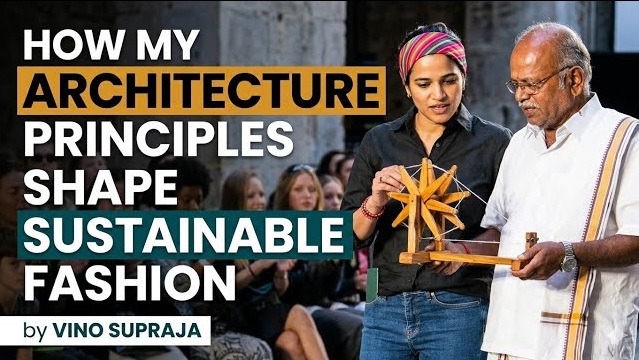
In a recent, deeply illuminating episode of Thali Connect, we sat down with Vino Supraja—a multidisciplinary creative powerhouse whose journey defies conventional career trajectories. From an accidental entry into architecture to becoming an internationally recognized sustainable fashion designer who showcased the indigenous Bhavani Jamakkalam at London Fashion Week, her story is a masterclass in curiosity, resilience, and the relentless pursuit of cultural storytelling.
For the modern designer, architect, or creative professional, this conversation offers profound insights into navigating global platforms while remaining fiercely rooted in local heritage.
The Accidental Architect: Finding Form in the Unknown
The genesis of a designer’s journey often shapes their entire creative philosophy. For Vino Supraja, the path to design was less a calculated ambition and more a leap of faith into the unknown. Growing up in the rural town of Vandavasi in Tamil Nadu, graduating from a government school in 1996, the career options presented to a young student were strictly binary: become a doctor or an engineer. The concept of “design” as a viable profession was virtually non-existent in the public consciousness of small-town India at the time.
“I was studying in a government school in a small town. For kids studying there, the idea of ‘what next’ was a huge question mark… I wanted to study Tamil literature, but my family was full of doctors and educators. My uncle came and told me about a new course called Architecture.”
The hook that drew her in was the promise of a curriculum devoid of physics and mathematics—a slight misconception that many architecture students can humorously relate to—centered instead around drawing and designing. This accidental enrollment proved to be the crucible that formed her creative identity.
Architecture school did more than teach her how to draft floor plans; it fundamentally rewired her brain. The rigorous five-year education instilled a profound understanding of form, space, order, balance, and proportion. These are not merely architectural terms; they are the underlying principles of all visual arts. Whether one is designing a skyscraper, framing a cinematic shot, or draping a couture garment, the foundational rules of aesthetics remain constant.
“Architecture, arts, sculpture, fashion, theater, music—they are not different. When you explore different art forms, you understand that the underlying principles are similar. The ‘Form, Space, and Order’ we studied is the base for everything.”
This robust foundation prepared her to face the world, not just as an architect, but as a fluid creative capable of adapting to any medium the universe presented.
Navigating Transitions: From Pentamedia to Global Nomad
The hallmark of a true creative is the refusal to remain stagnant. As the turn of the millennium brought forth the digital revolution in design, Vino Supraja found herself drawn to the burgeoning field of 3D animation. The introduction of software like 3D Studio Max and Maya prompted her to pursue animation at Pentamedia, seeking to explore computer-generated views and walkthroughs for architecture.
This detour opened the doors to the broader media landscape. Animation taught her the nuances of storytelling, cinematography, and spatial framing—understanding the psychological impact of a close-up versus a wide shot. After a brief period running a young architectural practice in Vellore with her husband, and taking time off for motherhood, she pivoted entirely. She transitioned into the world of media, working as a Radio Jockey and subsequently a Television Host for five years.
However, life as a trailing spouse soon took her across international borders. When her husband’s career in corporate planning for the automotive industry moved the family to China, and later to Detroit and Dubai, she faced the classic existential crisis of the expatriate partner. The thriving television career she built in Chennai was suddenly replaced by the isolating silence of high-rise apartments overlooking the Huangpu River.
“Every time I moved, it hit me. I was someone who put on makeup daily, sat in front of a live mic, and suddenly in China, there was nothing… I knew that being idle, while not wrong, would not give me happiness.”
Driven by an insatiable curiosity, she turned to education. In China, overcoming the language barrier of local university websites, she found herself enrolling in a fashion school. This decision wasn’t born out of a lifelong passion for clothing, but rather a pragmatic choice based on what was available in English. Yet, it led to her first runway showcase at Shanghai Fashion Week and two international awards, marking the birth of her new identity as a fashion designer at the age of 32.
Unmasking the Illusions of Sustainable Fashion
As she navigated the fashion industry across Detroit and Dubai, a pivotal moment of reckoning occurred in a classroom. The screening of the documentary The True Cost unveiled the harrowing realities of the global garment industry—the exploitation of workers, the environmental degradation, and the dark underbelly of mass production.
For a designer trained to create beauty, confronting the human and environmental toll of her chosen industry sparked a profound internal conflict. This awakening directed her toward sustainable fashion, long before it became a ubiquitous corporate buzzword.
In today’s market, sustainability is often reduced to “greenwashing”—a marketing gimmick where fast-fashion brands release ‘conscious collections’ featuring a trivial percentage of recycled materials, packaged in brown boxes stamped with green leaves. Vino Supraja sharply critiques this superficial approach, drawing parallels to the architectural world where painting a building green or adding a few solar panels is often passed off as ‘green architecture.’
“The past fifteen years, we have been tuned to buy mindlessly. Fast fashion arrived, making clothing hyper-affordable by masking the true cost of mass production and suppressed wages… True sustainability is about the lifecycle. How long will the product last before it becomes waste? And how many times will you wear what is already in your wardrobe?”
For her, sustainable design demands rigorous transparency. It requires designers to interrogate their supply chains: Who made this? Under what conditions? How transparent are the sourcing methods? She advocates for a pragmatic approach, acknowledging that 100% sustainability is an impossible utopia—merely existing generates a carbon footprint. However, the designer’s responsibility is to minimize that impact, making ethical choices at every stage of the design process, prioritizing longevity over fleeting trends.
The Globalization of Design: A Plea for Cultural Context
One of the most striking segments of the interview dealt with the homogenization of global design. In an increasingly connected world, cultural boundaries are blurring, leading to a sterile, uniform aesthetic that pervades both architecture and fashion.
Decades ago, stepping off a plane in the UK, Japan, or India offered an immediate, visceral sense of place. The clothing, the buildings, and the urban fabric were distinct visual languages shaped by history, climate, and local materials. Today, globalization has ushered in an era of ‘minimalist international style.’ A corporate glass-box office building in Gurugram looks identical to one in Dubai, Shanghai, or New York, blatantly ignoring the drastically different climatic conditions and cultural habits of the people inhabiting them.
“A building used to tell a story. You could look at it and say, ‘The Mughals were here, then the British.’ You could trace the historical background of the society. Can you say that about the buildings we construct today? They all look exactly the same, ignoring the local climate and the habits of the people.”
This erasure of identity is equally prevalent in fashion, where global fast-fashion dictates a uniform wardrobe worldwide. As designers, whether spatial or sartorial, there is an inherent responsibility to act as storytellers and custodians of heritage.
Vino Supraja argues eloquently that true design must carry the narrative forward. It is not about regressing to the past or stubbornly living in outdated structures. Rather, it is about extracting the essence of indigenous roots, materials, and detailing, and translating them into a relevant, modern context. The role of the designer is to ensure that the cultural continuum is not severed, bridging the gap between ancestral wisdom and contemporary lifestyle.
The Raw Theatricality of Therukoothu
To find a unique design voice on the global stage, one must often look inward. For Vino Supraja, her inspiration did not stem from extensive research trips or Pinterest boards, but from the deeply ingrained memories of her childhood in rural Tamil Nadu.
Growing up before the advent of the internet and ubiquitous cable television, her entertainment consisted of local temple festivals, Therukoothu (street theater), Parai drumming, and the vibrant, visceral energy of community rituals like the Mayana Kollai.
These indigenous art forms are masterful displays of raw design. Therukoothu, for instance, evolved in an era without microphones or stage lights. The music had to be loud and piercing to carry through the streets. The costumes were elaborately layered, entirely constructed with ties and knots long before the invention of zippers or Velcro. The facial makeup was a brilliant exercise in character design—calm lines for a peaceful character, exaggerated, aggressive strokes for a villain like Dushasana, designed to amplify their persona under the flickering light of oil torches.
“Look at the accessories—the crowns had mirrors on them. In the light of the fire torches, when the artist spun around, those mirrors would reflect light into the audience. That is pure, functional design.”
When she showcases her collections on international runways, she approaches them not merely as fashion shows, but as theatrical experiences heavily influenced by these childhood memories. She acts as a conduit, taking the “diamonds hidden in the dirt” of Indian villages and placing them under the spotlights of global fashion capitals.
The Bhavani Jamakkalam Revolution: Craftsmanship at London Fashion Week
The zenith of this philosophy was her groundbreaking showcase at London Fashion Week, which brought the traditional Bhavani Jamakkalam—a coarse, colorful woven cotton carpet native to Tamil Nadu—onto the global luxury stage.
This project was not born out of a calculated business strategy, but out of serendipitous curiosity. During a trip to Erode, she visited the weaving communities of Bhavani and discovered a craft in severe decline. The weavers were aging, the looms were gathering dust, and the younger generation was abandoning the trade for conventional corporate jobs because the craft no longer generated a sustainable income.
The traditional Jamakkalam had lost its relevance in the modern home. Once a staple used for sitting on the floor during auspicious occasions, it had been rendered obsolete by the widespread adoption of modern furniture. Preaching to the masses to abandon their chairs and sit on the floor to save a craft is a futile endeavor. Herein lies the true power of a designer: to evolve the material’s application to fit contemporary needs.
Vino Supraja deeply studied the material. The magic of the Bhavani Jamakkalam lies in a unique weaving technique called Surukku Thalluthal (tension pushing). While standard weaves show a grid of both warp and weft yarns, the Jamakkalam weave applies immense tension to the colorful horizontal weft, completely concealing the thick white cotton warp hidden inside.
Recognizing the striking, vibrant stripes as a visual identity stronger than many European luxury houses, she conceptualized transforming this floor covering into luxury bags and garments. This was an arduous technical challenge. The fabric was stiff, and any darting or diagonal cuts would expose the hidden white yarn. Furthermore, being pure organic cotton, it acted as a lint magnet.
Instead of concealing these ‘flaws’ with synthetic leather linings or chemical coatings, she embraced them. The irregularities, the lint attraction, the stiffness—these were the undeniable proof of human hands, the hallmarks of an authentic, natural craft.
Poetic Justice at Devonshire Square
The pinnacle of the project was the decision to take the master weaver, 68-year-old Sakthivel Ayya, to London Fashion Week. This was a logistical nightmare involving passports, stringent UK visa applications, and convincing a hesitant rural family to send their patriarch on a long-haul flight.
Yet, it was a profound ideological statement. For too long, the global perception of Indian artisans has been filtered through a lens of poverty and pity. Vino Supraja sought to shatter this stereotype, dressing Sakthivel Ayya in a crisp, pristine traditional Veshti and Angavastram, presenting him not as a subject of charity, but as a Master Craftsman demanding reverence.
When he walked the runway alongside the models, the room did not erupt in immediate applause. Instead, there was a stunned silence, followed by tears, and eventually, a roaring standing ovation. The audience, accustomed to seeing “Made in India” merely as a tag on a garment, was confronted with the human genius behind the fabric.
“The venue was Devonshire Square. I later found out from a historian that this exact location was once the fabric warehouse of the British East India Company. It was where they stored the fabrics taken from our weavers. It was incredibly fitting that an Indian weaver rose there like a phoenix.”
The ripple effect of this showcase was monumental. It garnered immense media coverage, sparked a renewed domestic interest in the craft, prompted government interventions, and catalyzed a resurgence of orders, breathing much-needed economic life back into the weaving community of Bhavani.
Embracing the Future: Tools, Technology, and the Myth of Failure
As the conversation shifted toward the future of design education and the integration of technology, Vino Supraja offered vital advice for the next generation of architects and designers.
In a world rapidly advancing toward Artificial Intelligence, there is often a purist anxiety regarding the loss of traditional skills like hand-sketching. Vino Supraja addresses this with pragmatic clarity. Before the pen, there was the chisel. The evolution of tools is inevitable. While traditional skills build a necessary cognitive foundation, stubbornly refusing to adapt to new technologies is professional suicide.
If AI tools like Midjourney are the new reality, the modern designer’s mandate is not to shun them, but to master them deeply.
“If you want to generate images using AI, then become the number one in prompt engineering. Learn the tool in-depth. Don’t just scratch the surface; learn it inside and out.”
The core of a designer’s value is no longer just the manual execution of a drawing, but the depth of their curiosity, their ability to ask the right questions, and their unique perspective—their style. A designer’s style is the culmination of their collective knowledge, their childhood influences, their musical tastes, and their life experiences. Tools will change, but the aesthetic vision remains uniquely human.
Furthermore, she dismantles the paralyzing fear of failure that stifles so much young talent. In the creative process, versions 1.0 and 2.0 might fail miserably. They might be relegated to the corner of a studio. But they are not failures; they are indispensable data points in the journey of iteration.
“There is no such thing as failure. It is just our narrative. You can narrate your life as a failure, or you can narrate the exact same events as a stepping stone to success. If doing something isn’t going to kill you, don’t be afraid to try it. Let people laugh. We all fell down when we were learning to walk as toddlers. Did we stop trying to walk because people laughed?”
The Thali Ethos: A Call to the Next Generation
For creators hailing from small towns in Tamil Nadu, looking at the intimidating, fast-paced global design industry, Vino Supraja’s trajectory stands as a beacon of possibility. The transition from the rural landscapes of Vandavasi to the elite runways of London was not paved with immense privilege, but with relentless curiosity, a willingness to be a perpetual student, and an audacious lack of fear.
At Thali, the belief has always been that architecture and design are not confined to the walls of a studio or the pages of a textbook. They are living, breathing entities shaped by history, material culture, and human interaction.
Vino Supraja’s ability to take the spatial principles of architecture, the narrative flair of media, and the tactile heritage of Indian handlooms to create a globally resonant luxury brand is the ultimate testament to the power of a holistic design education. It is a reminder that as designers, we possess the tools not just to build spaces or garments, but to revive communities, shift cultural narratives, and take our rightful place on the global stage—without ever forgetting where we came from.
