
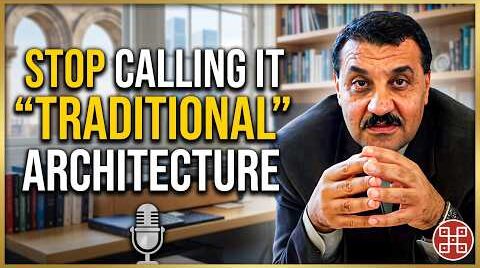
Architecture is often viewed simply as the art of building. But for Nezar AlSayyad, it is a sound argument—a narrative written in stone and social history. As a professor emeritus at UC Berkeley and a pioneering urban historian, AlSayyad has spent four decades reshaping how we see the cities of the Global South. He does not just study buildings; he decodes the hidden relationship between political power, colonial history, and the way ordinary people inhabit space. In 1988, he transformed the field by co-founding IASTE (the International Association for the Study of Traditional Environments), moving tradition away from romantic nostalgia and reframing it as a dynamic, living social science. Perhaps his most provocative contribution is his work on urban informality. While many saw squatter settlements as planning failures, AlSayyad identified them as a sophisticated logic of survival coexisting alongside the formal city.
His pen is as sharp as his architectural eye. In Cairo: Histories of a City, he traced two millennia of evolution, showing how rulers used grand projects to claim legitimacy. In Cinematic Urbanism, he explored a fascinating modern truth: our collective image of a city is built as much by the lens of a movie camera as it is by bricks and mortar. From his seminal work Forms of Dominance to his investigation of the fundamentalist city, AlSayyad consistently challenges us to look at the hidden forces of control and identity behind every skyline. Through his firm XXA (Office of Cross Cultural Architecture), he bridges the gap between theory and site-ready reality. With honors ranging from the Guggenheim Fellowship to the AIA Educational Award, his legacy is clear. He has shifted the architectural gaze from Western capitals to the complex, vibrant urbanities of the developing world, reminding us that every building is a story and every city is a living history.
Key Takeaways
Tradition is Not Static: Tradition is not a relic of the past. It is an ongoing, dynamic project that constantly redefines history to serve the present.
The Myth of “Pure” Architecture: No built environment is culturally pure. Cities thrive on hybridity, overlapping histories, and the messy collision of different eras.
Cinema Shapes Reality: Movies do not just document cities. They create a virtual reality that often becomes the standard by which we judge actual physical spaces.
The Rise of Manufactured Heritage: Global tourism often forces historic sites to present a sanitized, “fake” version of themselves, stripping away complex social and political realities.
The Architect’s Social Duty: The modern obsession with parametric forms and pure aesthetics has dangerously sidelined the social and environmental responsibilities of the architect.
Interviewee Introduction
This interview was conducted by Ar. Vidhya Lakshmi Rajasekar, a Chennai-based architect, educator, and heritage conservation specialist who actively bridges traditional building methodologies with contemporary architectural journalism. She is the driving force behind the Thali 100 initiative, an ambitious oral history and digital media project that aims to record 100 unique global voices of architects, urbanists, and historians. By documenting diverse regional approaches and practices, the initiative seeks to look beyond standardized Western narratives and build a comprehensive, open-access archive of contemporary architectural thought for professionals and the public alike.
The Double-Edged Sword of Colonialism
When we look at the legacy of colonial architecture, it is easy to see a one-way street of dominance. But the reality is far more entangled. Colonialism is fundamentally about taking over another culture’s territory and making it subservient. Colonizers, like the British in India or the French in North Africa, arrived and immediately tried to implant their own built environments. They wanted their buildings to reflect their power, not the culture of the colonized.
Yet, as AlSayyad points out, the process inevitably works both ways. The colonizers were deeply influenced by the traditional vernacular architecture they found. Over time, they absorbed these local designs and claimed them as their own.
Q: How do you perceive the evolution of vernacular wisdom versus the manufacture of heritage in post-colonial contexts?
Nezar AlSayyad: “Colonialism is a double-edged sword. Ultimately, the colonialists are very much influenced by the traditional and vernacular architecture that exists in a region. Over time, this architecture becomes their own. One of the best examples is the bungalow. The bungalow is just a hut that used to exist in Bengal. When the British landed in Calcutta, they found this structure was the easiest to live in. They refined it to accommodate their own taste, making the veranda very important. As the British moved to Australia, Egypt, and other parts of Africa, they took the Bengali hut with them. It became a structure associated with the British Empire, not Bengal. In California today, we have quite a lot of bungalows that have absolutely nothing to do with India, but their true origin is Indian.”
This naturalization of colonial forms forces a shift in perspective. AlSayyad argues that former colonized societies must eventually stop viewing this architecture as a foreign imposition. Instead, they must absorb it as part of their own layered history. He points to downtown Cairo as a prime example. Built in the late 19th century by architects trained in Paris, the city center was designed to look purely European. But local Egyptian builders soon began blending these Parisian styles with ancient Mamluk details. The result is a vibrant, hybrid environment. Today, Egyptians fiercely claim this architecture as their own heritage, proving that colonial spaces can be reclaimed and redefined by the people who live in them.
The Illusion of Manufactured Heritage
Tourism has drastically altered how cities preserve and present their history. As millions of people travel the globe seeking authentic cultural experiences, localities often reshape themselves to meet tourist expectations. AlSayyad explores this in his book Consuming Tradition, Manufacturing Heritage. He describes how towns deliberately package a sanitized version of their past for financial gain.
This process creates a strange, artificial dynamic. History is scrubbed clean. The messy, political, and often painful realities of the past are hidden away to ensure visitors have a pleasant vacation.
“Tourists like to consume the visual culture of the past but without being reminded of the entire social and political package that comes with it.”
AlSayyad points to Bali, Indonesia, where the pressure to maintain a specific traditional lifestyle has resulted in a staged reality. Residents in hundred-year-old homes alter their natural behavior to perform a version of themselves for tourists. They act as if they are on a stage.
We see this same phenomenon in the West. AlSayyad highlights Williamsburg, Virginia, an early British colonial town preserved for tourists. For decades, the Williamsburg Foundation presented a pristine version of 18th-century American history. But historians eventually realized the narrative was completely false because it erased the existence of enslaved people. When the foundation finally added slave quarters and hired Black actors to portray slaves, the effort backfired. Tourists did not want to confront the shameful realities of American history while on holiday.
Another striking example is Poundbury, a town in England developed by King Charles (then Prince Charles) in the 1990s.
Q: How does a place like Poundbury fit into this idea of fake interactions and manufactured heritage?
Nezar AlSayyad: “Poundbury was meant to look like a medieval town. It became a spot that tourists wanted to visit. But it’s a modern town created in the 1990s, with modern people living modern lives. The condition was that they could not have any visible signs of modernity. Satellite dishes are hidden. Indoor lighting looks like candles from the outside, and street lighting is still gas. It looks like a medieval town, but it’s a very clean medieval town that never existed in the Middle Ages. Medieval towns were filthy places to live. Architectural critics rightly criticized it as an airbrushed community that speaks neither to what England is today nor to what it was in the past. It is a replica of the built environment cleansed from any political or social dimension.”
Cinematic Urbanism: When the Reel Becomes Real
Architecture is not just experienced by walking down a street. In the modern era, our understanding of space is heavily dictated by cinema. In digital architecture studios today, students often watch films to study spaces that do not even exist yet. Movies like Fritz Lang’s 1927 masterpiece Metropolis imagined multi-layered train stations and video conferencing decades before they became reality. Filmmakers act as visionary architects, predicting the future of the built environment.
But AlSayyad goes a step further in his book Cinematic Urbanism: A History of the Modern from Reel to Real. He argues that movies do not just reflect reality; they actively construct our frame of reference. The virtual world of cinema is so powerful that it often overrides our experience of the physical world.
Q: How should architectural documentation evolve to capture the lived reality of a space rather than just its physical form?
Nezar AlSayyad: “I actually believe that cinema has the capacity to inform us and to allow us to think about physical space in a manner that we may not necessarily experience in real life. Cinema creates a parallel virtual world. Everybody thinks the camera captures reality and then we see it on the screen. I argue that is not true. The camera creates a reality.
I start the book with an anecdote from the Bollywood film Kal Ho Naa Ho. Shah Rukh Khan is dancing on the Brooklyn Bridge, and behind him is the Statue of Liberty. I was walking across the real Brooklyn Bridge with a young boy, and he asked me, ‘Where is the Statue of Liberty?’ I told him you cannot see it from this bridge. He went home, put on the film, and showed me: ‘Look, he is dancing on the bridge and the Statue is right behind him.’ For this child, reality did not matter. What mattered was what he saw in the film. The virtual became the frame of reference by which he evaluated the real.”
This phenomenon proves that artists and filmmakers are deeply proactive. They merge landmarks, invent surveillance cities, and manipulate space to tell a better story. By doing so, they force architects and the public to question what they actually know about reality.
The Crisis of Social and Environmental Responsibility
As cities grow and new buildings rapidly alter the skyline, the role of the architect is heavily scrutinized. We are living in an era of dwindling resources and severe environmental degradation. Future generations may not enjoy nature in the same way we do today. This places a massive burden on the architecture profession.
Unfortunately, the industry is struggling to meet this challenge. Catch-all phrases like “environmental sustainability” and “social resilience” are thrown around, but they often lack real substance in architectural curricula. While there is a growing trend of focusing on recycled materials, it is still in its infancy.
The greater loss, however, is the erosion of the architect’s social responsibility. During the early modern movement, architecture was deeply tied to a political and social agenda. Buildings were designed to satisfy the actual needs of communities. But as the 20th century ended, a shift occurred.
Q: With so many buildings coming up today, what should be the responsibility of an architect towards society and the environment?
Nezar AlSayyad: “Architecture unfortunately goes through phases. With postmodernism and the emergence of parametric design—the emergence of the ‘blob’—we threw out a considerable part of the modern agenda. We ended up with architecture that was socially irresponsible. Architects became fascinated with pleasing clients through aesthetic exercises that sometimes reached the point of absurdity. As long as they got paid and published, that was all that mattered.
I taught at Berkeley for 38 years, a school completely known for its social engagement. During my years there, I saw this philosophy literally dwindle down to the point of almost completely disappearing. A new generation of architects was much more interested in form-making. Social responsibility was an afterthought. Architecture is a science and an art simultaneously. The product of what an architect does exists within a community. Even if a building is private, its form is public. The feeling of ‘I don’t owe you anything as a community’ has created a divorce between architecture and a socially responsible position.”
This disconnect is glaring in the developing world. In villages across Tamil Nadu, for instance, traditional courtyard houses are rapidly being replaced by stark, modern, glass-clad buildings. To a trained architect, this sudden shift ruins the neighborhood’s visual identity. It feels thoughtless.
But AlSayyad offers a humbling counter-perspective. He argues that architects must stop dictating what ordinary people should want. If a modern material is cheaper and provides a better lifestyle for a villager, we cannot fault them for abandoning traditional mud or rammed earth. The true challenge for a contemporary architect is to modernize these vernacular forms using affordable, sustainable materials without pricing the locals out.
“I go to a house in the American Southwest that is worth $2 million, but it’s made with mud. It’s ironic at a time when mud is the material that poor people in the Middle East and Asia actually build with.”
The Messy Reality of Hybrid Histories
When documenting the evolution of a city, it is tempting to categorize buildings into neat historical boxes: ancient, colonial, modern. We mourn the loss of a neighborhood’s cohesive identity when new styles interrupt the old. But this desire for a singular, cohesive identity is flawed.
AlSayyad firmly believes that there is no such thing as “pure” architecture. The built environment is inherently messy. Different eras constantly collide, borrow from one another, and overwrite previous generations.
Q: Do you believe in a pure cultural architectural style, or is true value found in the messy overlaps where different histories collide?
Nezar AlSayyad: “I categorically reject the term pure. I believe that everything is actually hybrid. Sometimes it’s hybrid to an extent that it’s tainted, but sometimes it elevates it beyond its origin. I don’t believe in the purity of anything at all.
Look at ancient Egypt. The Temple of Luxor is 3,800 years old. During the Mamluk era, it was buried under sand. Unaware of the temple beneath, Muslims built a mosque on top of it. In the 19th century, the temple was finally excavated. So what do you do with a 1,200-year-old mosque built on top of a 3,800-year-old temple? Do you demolish the mosque? Today, the two coexist. The mosque is still functioning. It forces tourists to see the layers of history.”
This messy collision is visible globally. Early Christians carved out the interiors of ancient Egyptian temples to create churches. Hagia Sophia in Istanbul transitioned from a Byzantine Orthodox church to an Ottoman mosque, then to a modern museum, and recently back to a mosque under a fundamentalist government—all while retaining contrasting religious iconography.
These hybrid spaces are authentic precisely because they reflect the turbulent, shifting reality of human history. They speak a complex language that architects must learn to embrace rather than erase.
The Power of Inadvertent Documentation
Documentation plays a critical role in navigating these hybrid histories. But its value is rarely immediate. Architects and students who document traditional villages or map old industrial expo sites often wonder who will actually benefit from their work.
AlSayyad argues that documentarians should not worry about the immediate result. If they do a thorough job, the accident of history will determine its ultimate value. He shares a remarkable story from the 1893 Chicago World’s Fair.
An Austro-Hungarian architect named Max Herz was commissioned to design the Egyptian pavilion. Herz traveled to Cairo and meticulously documented a traditional Mamluk building known as a Sabil Kuttab (a water fountain with a nursery school above it). He measured it exactly to scale and even took original metalwork back to Chicago to build his wooden replica.
Nearly a century later, in the 1970s, a German archaeological group wanted to restore the original crumbling building in Cairo. The only reliable blueprints in existence were the drawings Herz had made for the World’s Fair.
“What we have in Cairo today is a building that looks more like the replica that was in Chicago than the original,” AlSayyad notes. “Because we don’t know what the original truly looked like anymore. This is the power of documentation.”
We see this locally as well. After a recent industrial expo in Chennai, most pavilions were dismantled to build a residential zone. However, a local film had shot an entire song sequence inside the temporary expo. Decades later, that movie footage became the primary historical document proving what the architecture looked like, driving locals to rediscover surviving archways and walls hidden in the new neighborhood.
Redefining Tradition for the Future
How do we weave all these threads together? If colonialism, tourism, cinema, and hybridity constantly distort our built environment, what exactly are we trying to preserve?
The answer lies in how we define tradition. It is the core philosophy behind IASTE. Tradition is not a static set of features locked in the past. It is an active process of transmission.
Q: If tradition is a process of transmission rather than a static legacy, what is the role of the contemporary architect today?
Nezar AlSayyad: “The operational definition we use at IASTE is that tradition is always changing and always dynamic. It is a constant project that looks at the past but redefines it for the purposes of the present. There is no tradition that is static. For anything to be a tradition, it was an innovation at some point in time.
The task of an architect in the modern era is to understand the tradition of his or her time. You have to relate that tradition to the identity of the physical environment. Physical environments do not have an identity of their own; they are endowed with the identity of the people who inhabit them. Knowing that we live in 2026, in a post-truth society where media has taken over, architects need to grapple with these competing realities. You must create something that belongs to the community, rather than just focusing on the self-expression of the architect.”
Looking Forward
As cities in the Global South continue to expand at a breakneck pace, the lessons from Nezar AlSayyad are more urgent than ever. We must move past the desire for architectural purity and embrace the messy, hybrid realities of our streets. Whether we are navigating the lingering shadows of colonial design, fighting against the artificial curation of tourist towns, or struggling to maintain social responsibility in a profit-driven industry, the goal remains the same. Architecture must serve the people who live in it. By redefining tradition not as a fragile relic to be trapped in amber, but as a bold, living tool for innovation, architects can finally design cities that honestly reflect the complex, ever-changing story of human survival.
