
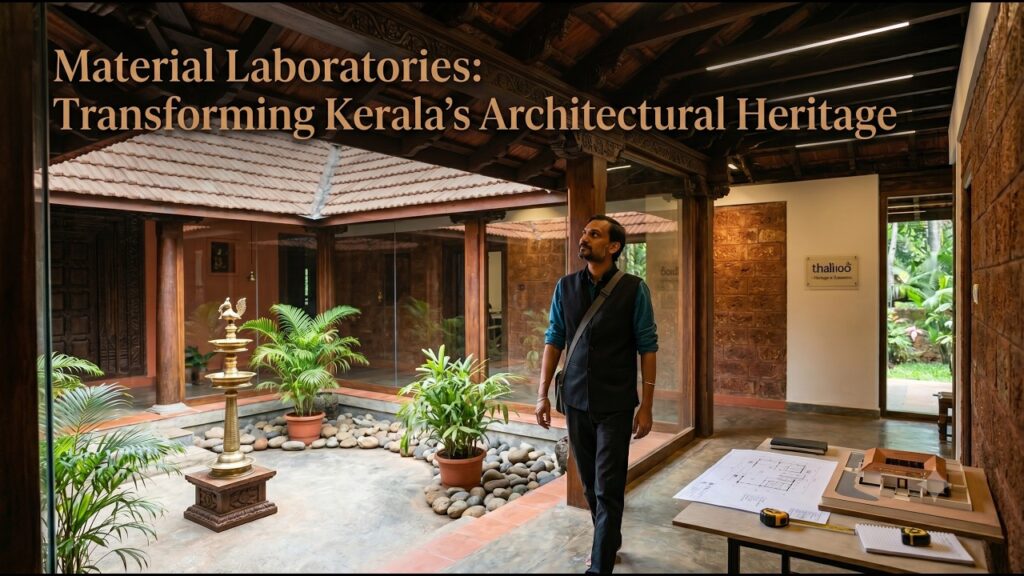
As an architecture journalist, I often hear the debate between modern convenience and traditional wisdom. We are constantly sold the idea that newer is stronger, and that “expensive” equates to “beautiful.” However, when you sit down with seasoned practitioners who actually build with their hands in the dirt, a very different, much more grounded reality emerges.
Recently, we had the opportunity to glean insights from Architect Vinodkumar MM, who has been practicing out of Thrissur, Kerala, since 2000. For over 25 years, his firm has engaged in a staggering variety of projects—from royal palaces and central temples to urban heritage waterways, modern residences, and grassroots workshops. His perspective bridges the gap between the everyday homeowner and the technical architect, reminding us all that true architecture is a multi-sensory experience, not just a pretty picture on a screen.
Here is a deep dive into the philosophy, practice, and practical wisdom of an architect who designs close to the earth and close to the people.
The Myth of the Fragile Past: Why Traditional Materials Outlive Us
There is a pervasive modern misconception that traditional building materials are inherently weak or temporary, while modern materials like concrete are invincible. Vinodkumar strongly refutes this, pointing to the living history of Indian architecture.
“If you see a concrete building today, I don’t think its life is more than 25, 30, 50 years. It’s a misconception that traditional build materials don’t last long. It lasts much longer than modern materials if you use it the right way.”
He notes that across Kerala, palaces and temples built using lime, timber, and stone have comfortably survived for 300 to 500 years. The longevity of a structure is not born from the industrial nature of its components, but from the harmonious, correct application of time-tested materials.
Material Lifespan at a Glance
| Material Type | Examples | Estimated Lifespan (per Vinodkumar) | Key Characteristics |
| Traditional | Lime, Timber, Stone, Laterite, Oxide | 300 – 500+ years | Time-tested, ages gracefully, climate-responsive, requires correct application. |
| Modern | Standard Reinforced Concrete | 25 – 50 years | Industrially produced, highly standardized, prone to faster degradation over decades. |
This is a critical revelation for homeowners: investing in traditional materials is not a step backward into the past, but a step forward into multi-generational durability.
A Practice Rooted in Earth, Heritage, and Community
Vinodkumar’s firm cannot be boxed into a single category. Over the past two and a half decades, his explorations have remained close to the earth and close to the people. His portfolio is a vibrant tapestry of civic duty, historical preservation, and contemporary living.
His diverse range of projects includes:
- Restoration of the old palace and the central temple in Thrissur.
- Revitalizing the old heritage waterway in Thrissur, which had lain unused for 30 to 40 years.
- Rejuvenating heritage water bodies and ponds, giving them new life within the town.
- Designing modern residences and interiors that borrow deeply from conservation principles.
- Working with a British-period guest house, learning from the craftsmanship of the era.
Empowering the Local Ecosystem
Architecture, in Vinodkumar’s view, is not a solitary genius sketching in a vacuum. It is a collaborative, community-driven effort. His practice thrives on a mixture of trainees from across the country, local craftsmen, and interesting clients.
To take this community integration a step further, his team is currently setting up the Ay Store. Located right at their workspace, this initiative aims to collaborate with local craftsmen, local women, and self-help groups to display and sell contemporary local products.
Furthermore, as the convenor of INTACH (Indian National Trust for Art and Cultural Heritage) in Thrissur, he organizes heritage walks and workshops. Through his own firm’s workshop series named “I”, they explore sustainable projects—such as taking a group of students to a sustainable home located between Thrissur and Palakkad on the 14th of the month.
The Economics of Beauty: Consciousness Over Capital
Perhaps the most liberating takeaway for the common man from Vinodkumar’s philosophy is his stance on architectural beauty and project budgets.
“We believe something very strong that beauty doesn’t depend on expensive products… Beauty comes out of consciousness. Consciousness of using materials, consciousness of life. That’s an Indian concept actually.”
In a market flooded with premium, imported finishes, Vinodkumar champions the idea that beauty is a byproduct of honesty. When there is truth and consciousness in how materials and structures are used, the resulting space will naturally be beautiful. You do not need to spend exorbitant amounts of money to achieve aesthetic brilliance.
His own office serves as a testament to this ethos, utilizing:
- Exposed concrete
- Doors without frames
- Reused timber
- Old tiles
- Lime and oxide finishes
The 12-Lakh House: A Case Study in Resourcefulness
To prove that low budgets do not mean low quality, Vinodkumar shares the story of a home designed for a photographer friend. The budget was strictly 10 to 12 lakh rupees.
Instead of buying cheap, poor-quality modern materials, the client and architect sourced high-quality recycled products. They procured tiles and bricks from an old tile factory, and salvaged shutters from an old, dismantled house. The project was successfully completed within the tight budget.
The caveat? Time and Trust. Sourcing recycled materials and integrating them beautifully takes immense effort. The client must implicitly trust the architect and respect the time it takes to execute such a unique, conscious process.
The “Scriptless” Design Process: Discovering the Site
For architects and design students, Vinodkumar offers a masterclass in site-responsive design. He compares the architectural process to an indie movie director shooting without a rigid script.
While an architect has a basic plan and a vision for the space, the true design reveals itself through the site.
You cannot resolve everything at the drawing table. The reliance on computers limits the bodily experience of the site.
Multiple site visits are non-negotiable. Only by standing on the land repeatedly can an architect notice the nuances: the exact path of the sun, the direction of the breeze, or a specific tree that perfectly frames a window view.
Adaptability is key. As the project evolves and the structure rises, the design must remain flexible enough to adapt to these new discoveries.
There is No “Bad” Site
When asked about challenging sites, Vinodkumar is unequivocal: there is no such thing as a good site or a bad site. Every site is good; the success lies in how the architect explores and responds to it.
For instance, his firm recently designed a project in an Agraharam (traditional Brahmin neighborhood) in Pudukad. The site was incredibly narrow—just 5 meters wide by 50 meters deep—and surrounded by old, traditional houses. The architectural concept had to focus on how to gel with this historical context. You cannot simply drop an alien structure into a culturally rich neighborhood.
Similarly, if a site is noisy or in a dense urban setting, the architecture must simply adapt to cut off the noise and respond to the specific conditions.
Climate, Comfort, and Championing Local Sustainability
India is not a monolith. It possesses a vast array of climatic zones, meaning that architectural solutions must be highly regional.
In Kerala, the climate is characterized by high humidity, intense heat, and heavy rainfall. Vinodkumar looks to traditional masters for cues on how to handle these extremes. He points to traditional overhangs that protect walls from the sun, and the ingenious Kulapuras (traditional bathhouses attached to ponds), where occupants experience the perfect intersection of natural light and breeze cooled by the water’s surface.
However, “comfort” in Kerala is vastly different from comfort in Tamil Nadu or Delhi. Understanding regional comfort is the first step. The second step is blending this traditional wisdom with modern research—knowing how to strategically use double glazing, reflective materials, or specific roof treatments to reduce heat gain and minimize the need for artificial air conditioning.
The Burden of Proof on Architects
Vinodkumar raises a highly critical issue regarding sustainability in India today.
Multinational companies possess the financial backing to research, test, and mathematically certify their industrial products as “sustainable” or “green” for official rating systems. Conversely, local tiles, country bricks, or materials crafted by a village mason lack these formal certifications. When architects attempt to get a green rating for a building using local materials, they often hit a wall because the energy-saving values of these indigenous products are not formally documented.
Here, Vinodkumar issues a call to action for the architectural community:
Architects and researchers must put in the extra effort to calculate, document, and prove the sustainability of local materials. We cannot wait for village artisans to fund scientific research. The architectural fraternity must prove to the world that utilizing a local craftsman and regional materials inherently saves energy and embodies true sustainability.
Beyond the Screen: A Plea for Multi-Sensory Architecture
As the interview draws to a close, Vinodkumar addresses the elephant in the room: the digitalization of architecture.
We are living in an era flooded with images. Social media platforms like Instagram have reduced architecture to purely visual, 2D perspectives. Clients demand 3D renders that look perfect on a screen, and architects are increasingly designing for the photograph rather than for the human being.
“The world is getting very visual… But true architecture goes beyond images. It is a multi-sensory, multi-dimensional experience.”
While acknowledging that digital tools are helpful and shouldn’t be avoided, he warns against losing the essence of the craft. Architecture is meant to be experienced through the body—feeling the texture of an oxide wall, hearing the acoustics of a high timber ceiling, smelling the damp earth after rain hits a lime-plastered facade, and feeling a cross-breeze channel through a perfectly placed courtyard.
Conscious architecture that prioritizes human experience over viral imagery transcends time. It holds a value that will survive long into whatever the future holds, outlasting any fleeting digital trend.
Conclusion
Architect Vinodkumar MM’s 25-year journey from Thrissur is a powerful reminder of what architecture is meant to be. It is not an exercise in excessive spending, nor a quest for the perfect digital image. It is an honest, conscious collaboration between the architect, the craftsman, the client, and the earth itself. By placing our trust in time-tested materials, responding authentically to our local climates, and designing spaces that engage all our human senses, we can build homes that don’t just look good for a moment, but live beautifully for centuries.
